Istanbul
"And the panorama unfolds: to the left, Pera, far more beautiful when seen from afar; to the right, Istanbul in all its splendour; ahead, Scutari of Asia, a veritable grove of plane trees, fig trees and acacias, with a multitude of little purple houses nestled beneath the foliage —and there, suddenly, is the Bosphorus"
Claude Farrère, L’Homme qui assassina, Librairie Paul Ollendorff, 1907
Cradled by a Sapphire Bosphorus
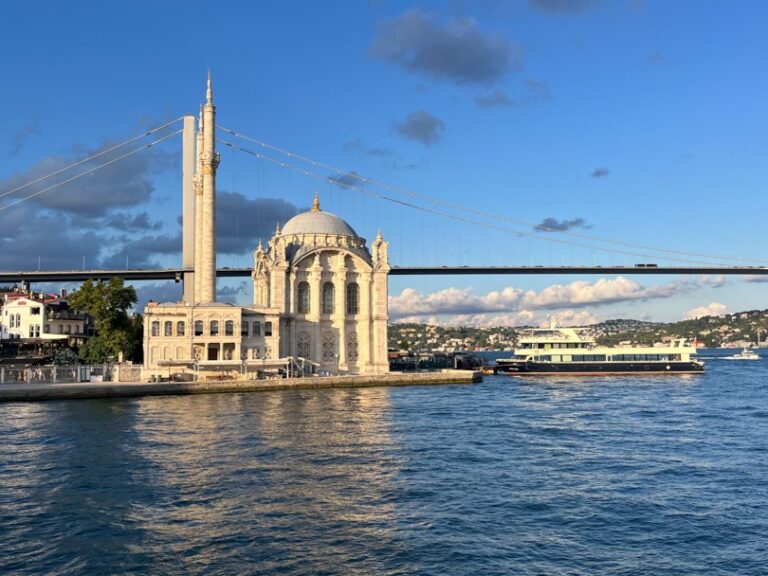
Istanbul, glorious capital of two great empires, poised between Asia and Europe, seems to have sprung from the waters of the Bosphorus. For centuries, its changing blues have carried ships between shores lined with palaces, wooden yalis, domes and minarets. More than a frontier between continents, the strait is the thread that binds the city’s two souls, European and Islamic, into a landscape unlike any other.
Away from the water, Istanbul grows louder in the colourful confusion of its bazaars, before spilling towards Galata Bridge, where restless crowds pass fishermen standing motionless above the Golden Horn. Beyond, the façades, passages and shops of Pera and Taksim evoke the cosmopolitan Istanbul of another age, while around the Galata Tower, evening fills the old stone streets with crowded tables, music and voices. Here, worlds that elsewhere seem distant coexist within a few streets, and centuries are never quite as far apart as they appear.
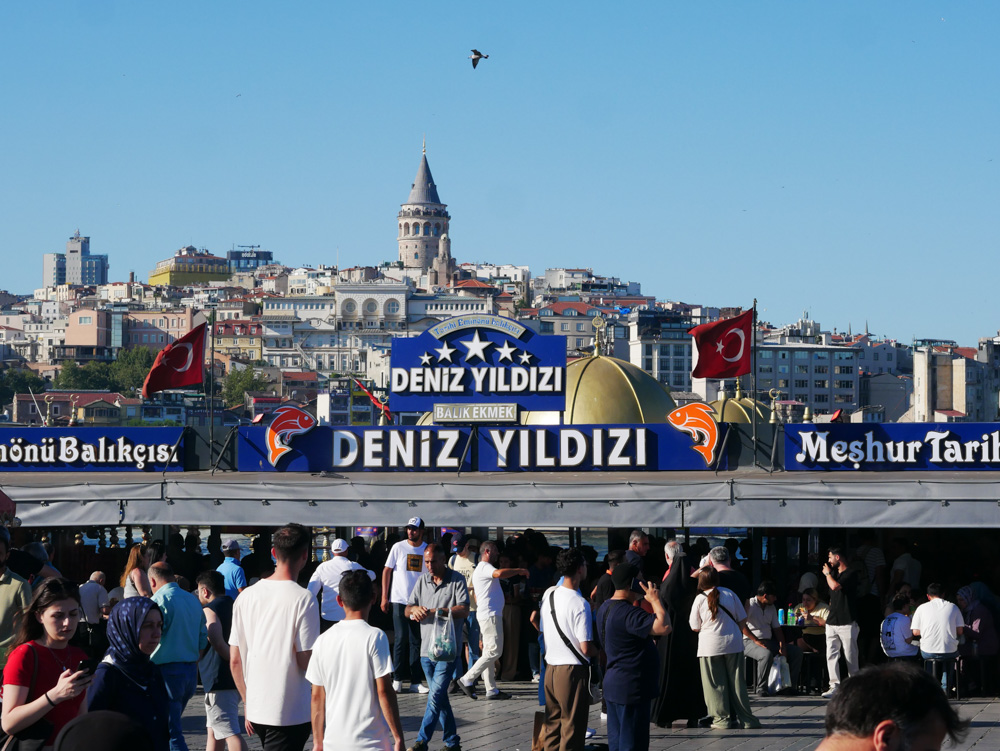
A bustling scene on Istanbul’s Galata waterfront, with the famous fish restaurants of Eminönü in the foreground and the Galata Tower rising above the historic skyline.
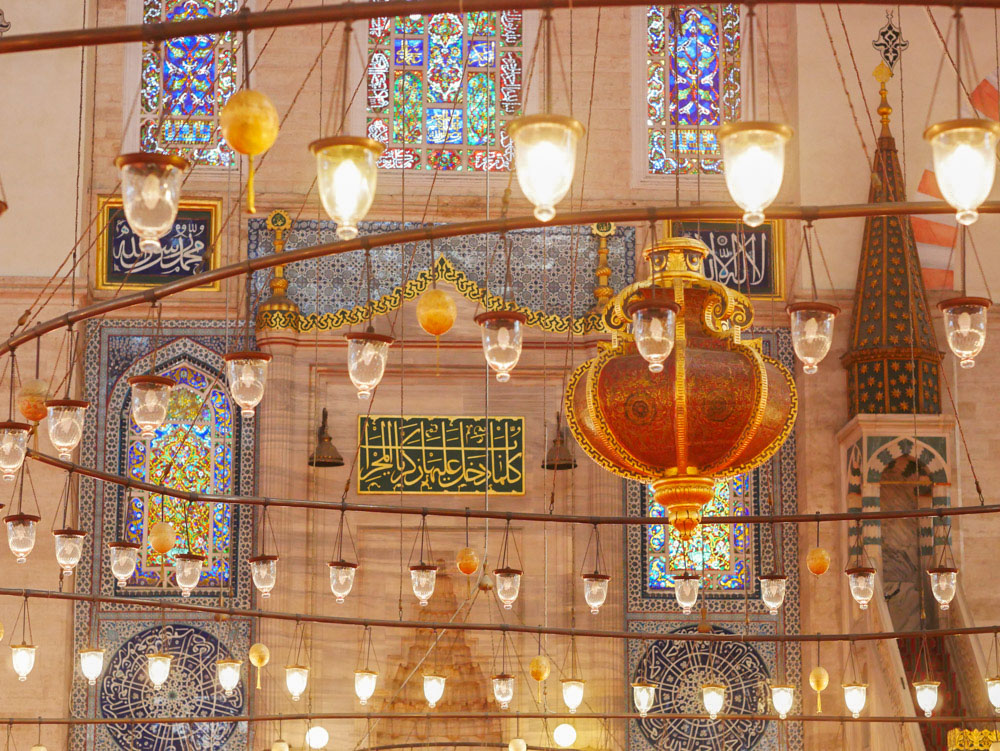
The richly decorated interior of the Süleymaniye Mosque, with glowing stained-glass windows, intricate calligraphy and its magnificent suspended lamps and chandeliers.
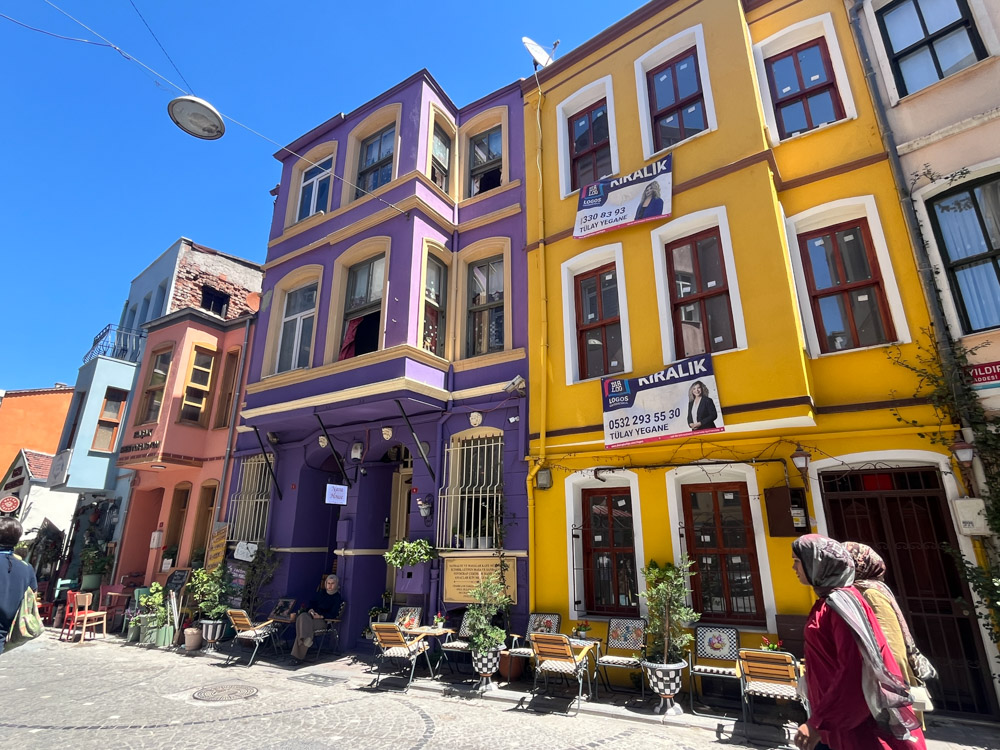
Colourful historic houses and pavement cafés line the picturesque streets of Fener, one of Istanbul’s most characterful old neighbourhoods.
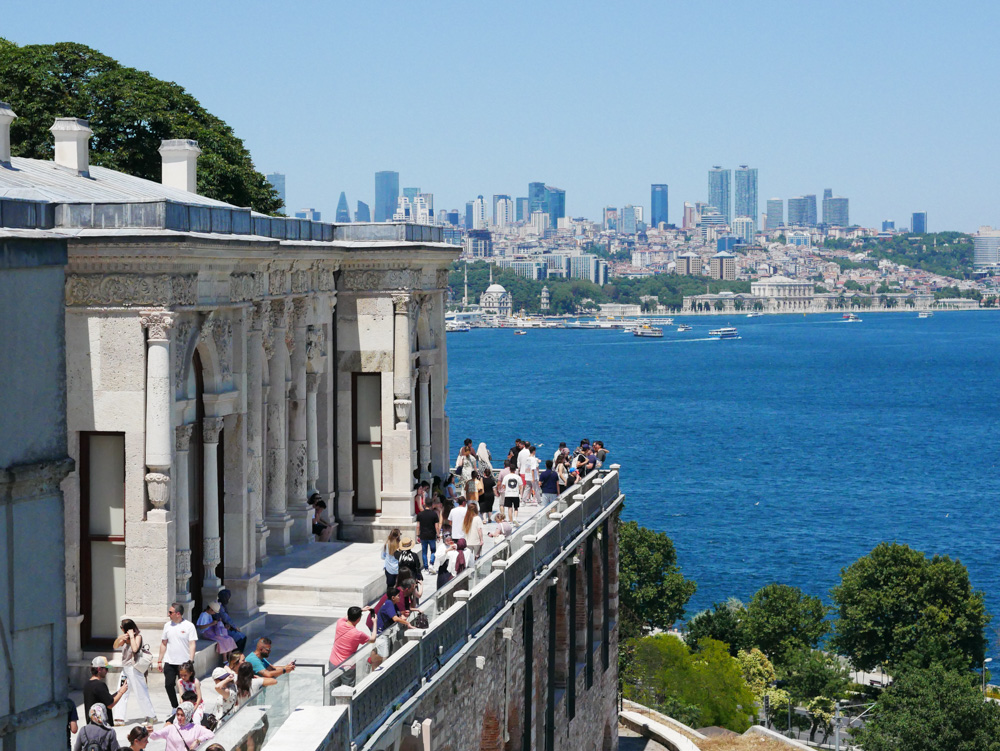
A magnificent view over the Bosphorus from Topkapı Palace, where Ottoman architecture overlooks the blue waters and Istanbul’s modern skyline beyond.
Byzantium: A thousand years of splendor
Constantinople was born as an imperial capital in 330, when Constantine the Great transformed ancient Byzantium into his “New Rome”, strategically set between Europe and Asia and commanding the passage between the Black Sea and the Mediterranean. Protected by formidable walls and enriched by trade, its exceptional position made it the political and economic heart of the Eastern Roman Empire, ruled by some 90 emperors over more than 11 centuries. From here flourished a civilisation renowned for its diplomacy and commerce, its preservation of the Greco-Roman heritage, and above all its dazzling Christian art and architecture, embodied by Justinian’s Hagia Sophia.
As the empire expanded and contracted, Constantinople became ever more central to its survival, until crusades, internal struggles, economic decline and the advance of rival powers gradually reduced Byzantium to little more than its magnificent capital and its surroundings. On 29 May 1453, after a 53-day siege, Mehmed II’s Ottoman forces breached the ancient Theodosian Walls and brought the empire to an end. Yet Byzantine Constantinople remains surprisingly visible beneath modern Istanbul: in Hagia Sophia, the Basilica Cistern, the Hippodrome, the formidable Theodosian Walls and the exquisite Byzantine mosaics of the former Chora Church (today the Kariye Mosque), fragments of a vanished city through which its imperial past can still be read.
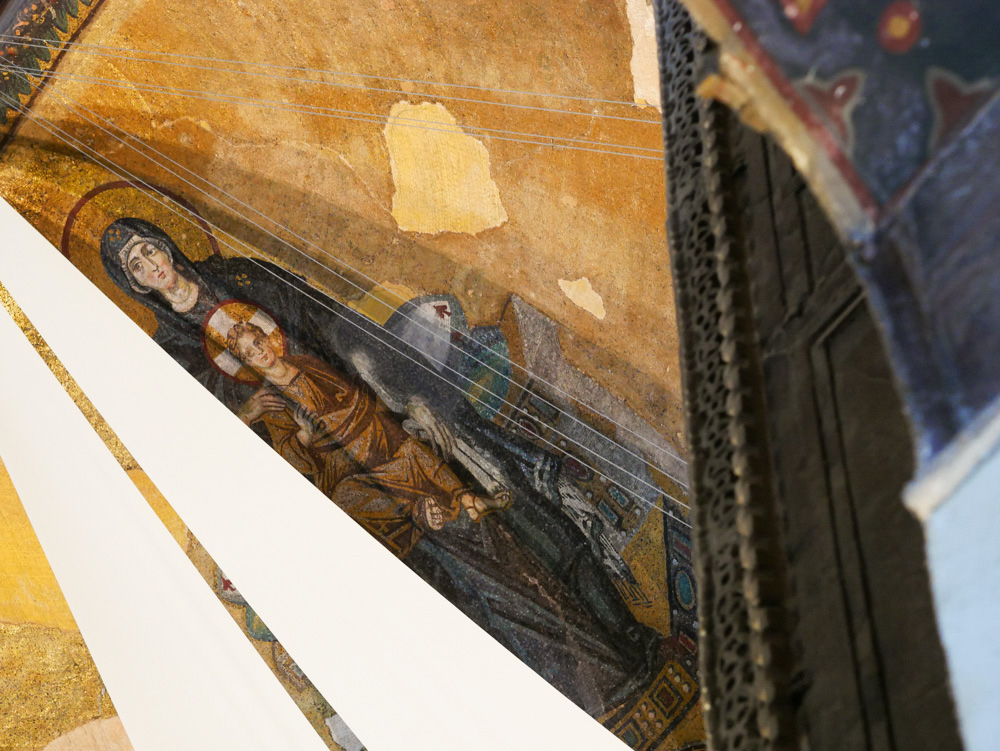
The Virgin and Child emerge from Hagia Sophia’s golden Byzantine mosaics, an enduring testimony to Constantinople’s Christian past.
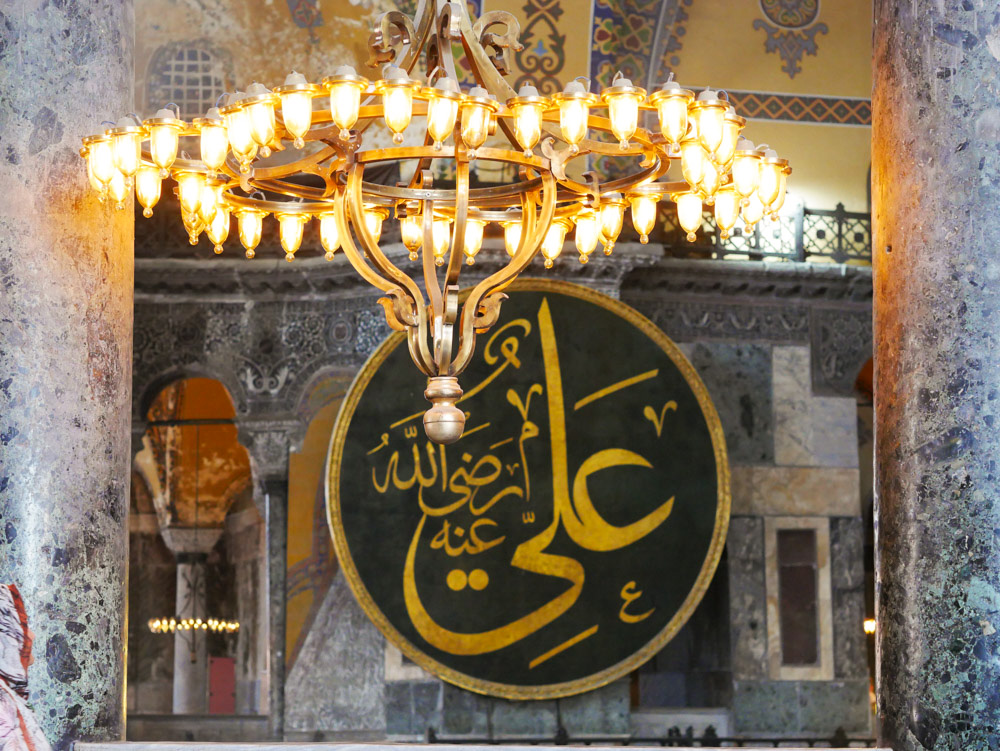
Layers of Hagia Sophia’s extraordinary history: monumental Islamic calligraphy framed by ancient marble columns and the warm glow of suspended lamps.
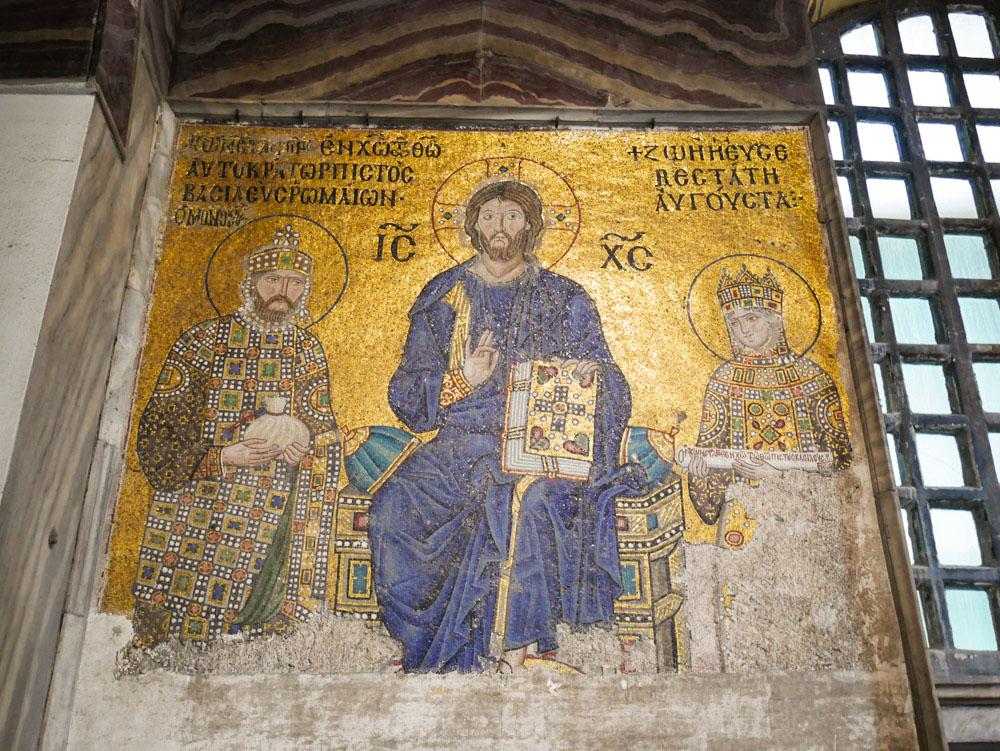
A magnificent Byzantine mosaic in Hagia Sophia depicting Christ Pantocrator flanked by Emperor Constantine IX Monomachos and Empress Zoe.
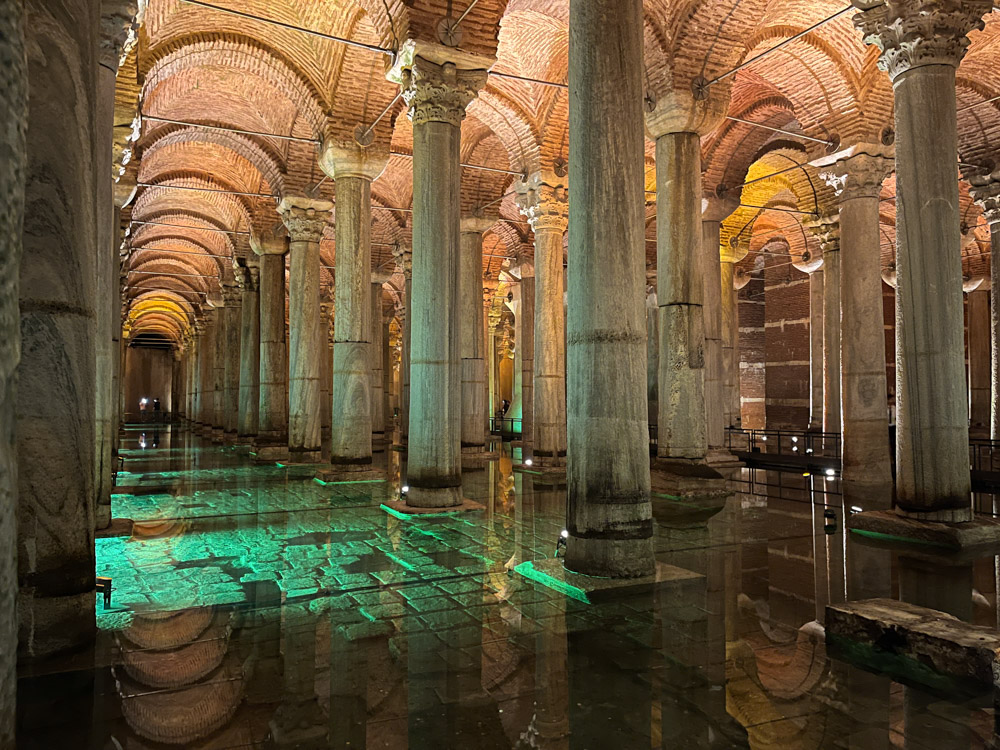
The haunting interior of Istanbul’s Basilica Cistern, where hundreds of ancient marble columns rise from the water beneath softly illuminated brick vaults.
Ottoman Constantinople, the city of Sultans
With the conquest of 1453, Constantinople became the heart of an expanding Ottoman world, an empire whose power rested on the authority of the sultan, a formidable military machine and control of the great trade routes linking Europe, Asia and the Mediterranean. From Topkapi Palace, successive sultans presided over an elaborate imperial system of court, harem and administration, while the “Sublime Porte” came to symbolize the government itself and its sophisticated diplomacy.
As Ottoman territories stretched deep into both Europe and Asia, the capital absorbed influences, peoples and goods from across three continents, becoming one of the world’s great cosmopolitan cities. Its skyline was transformed by monumental mosque complexes — above all Süleymaniye and the Blue Mosque — while Topkapi embodied the classical Ottoman court; centuries later, Dolmabahçe and Beylerbeyi palaces revealed an empire increasingly fascinated by European tastes.
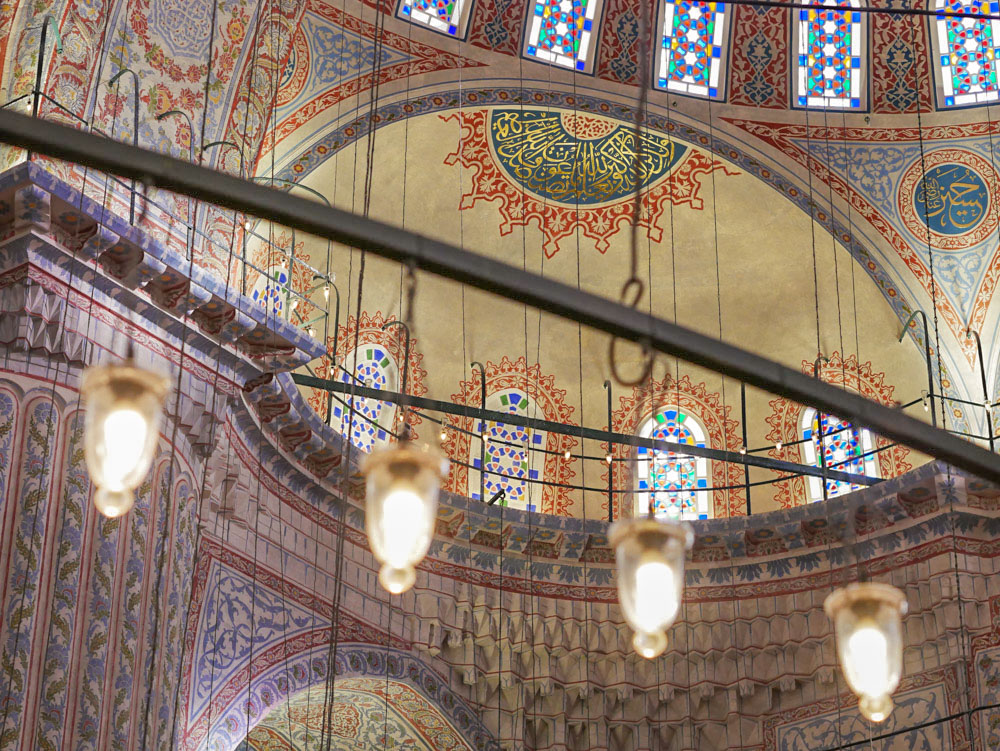
Stained-glass windows, elegant calligraphy and suspended lamps illuminate the richly decorated interior of Istanbul’s Blue Mosque.
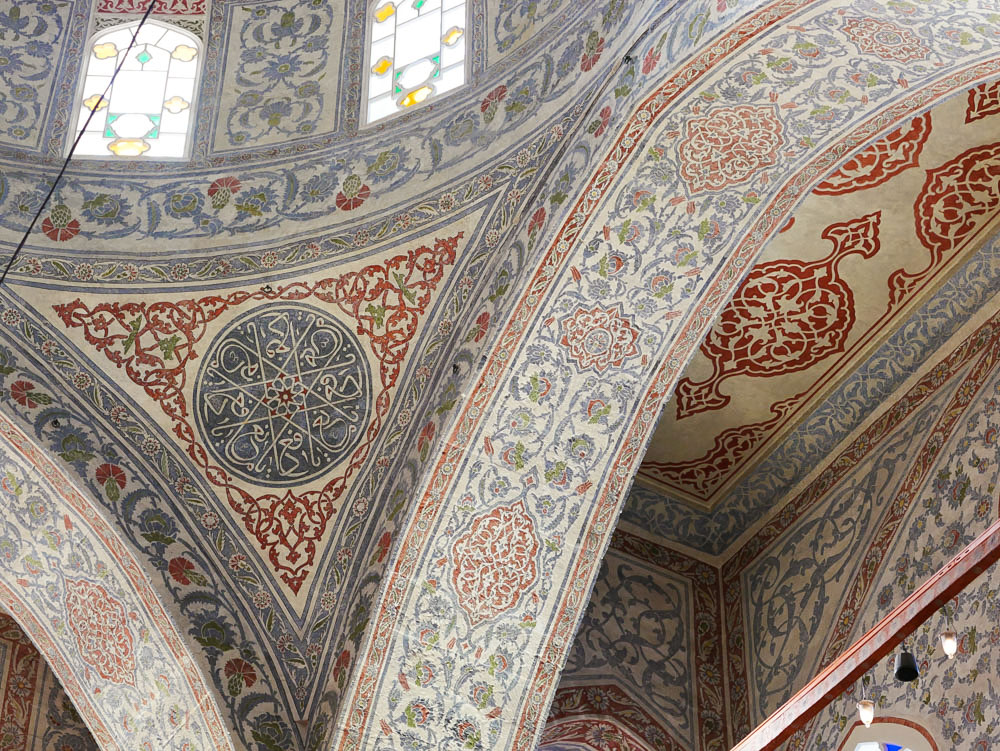
The soaring arches of the Blue Mosque, covered in delicate floral and geometric ornamentation in the blues, reds and soft tones characteristic of Ottoman decoration.
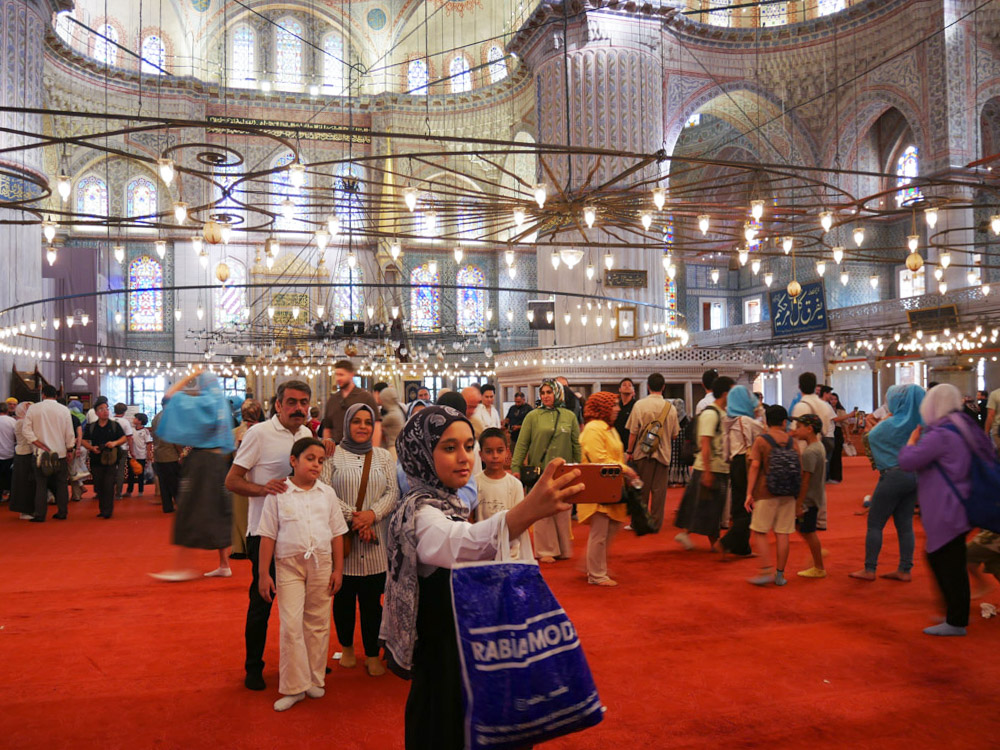
The vibrant interior of the Blue Mosque, where visitors gather beneath a glowing canopy of suspended lamps, stained glass and exquisite Ottoman decoration.
The invasion of Europe
From the late 17th century, military setbacks, nationalist movements, economic pressures and the growing power of European states gradually weakened Ottoman rule, despite successive attempts at reform and westernisation. Defeat in the First World War brought the empire to its end, and the sultanate was abolished in 1922. Yet Ottoman Istanbul remains everywhere: in its mosques and palaces, its bazaars, fountains, hammams and wooden houses, a cityscape in which five centuries of imperial life are still vividly present.
Long before the Ottoman Empire disappeared, another Istanbul had begun to emerge across the Golden Horn: in Pera and Galata, embassies, banks, theatres, grand hotels, department stores and apartment buildings reflected the growing presence of European merchants and diplomats and the westernising ambitions of the late Ottoman elite.
After the Republic was founded in 1923, Mustafa Kemal Atatürk accelerated this transformation, replacing the Arabic-based Ottoman script with the Latin alphabet, promoting Western dress and civil law, abolishing the caliphate and religious courts, and placing public life firmly within a secular state. Ankara became the new capital, yet Istanbul, as the ancient city was now officially known to the world, remained Turkey’s great cosmopolitan metropolis, gradually spreading far beyond its historic shores and embracing modern architecture, commerce and culture.
The Europeanised world of the late empire can still be traced along İstiklal Avenue, through the passages and façades of Pera, around Galata and in landmarks such as the Pera Palace; contemporary Istanbul emerges in Karaköy and Galataport, in its galleries and design spaces, and at Istanbul Modern, where the old port city meets the creative energy of the twenty-first century.
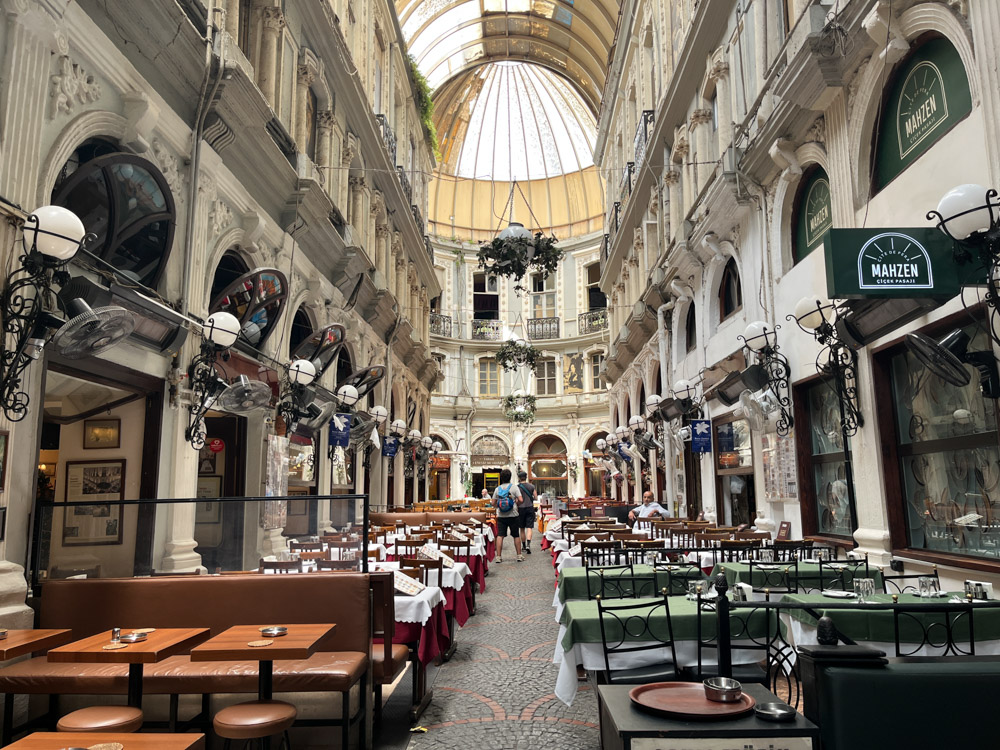
Inside the Cité de Péra (Çiçek Pasajı), where ornate 19th-century architecture provides a grand setting for its lively restaurants and taverns.
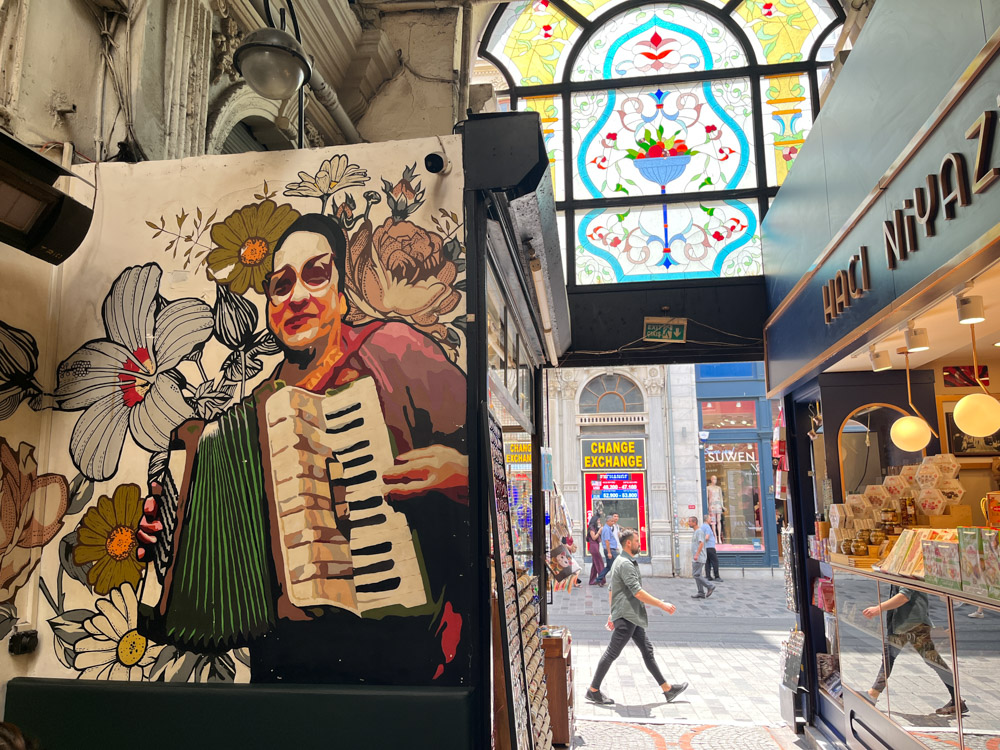
Old Pera meets contemporary Istanbul: colourful street art and stained glass enliven one of Beyoğlu’s historic passages.
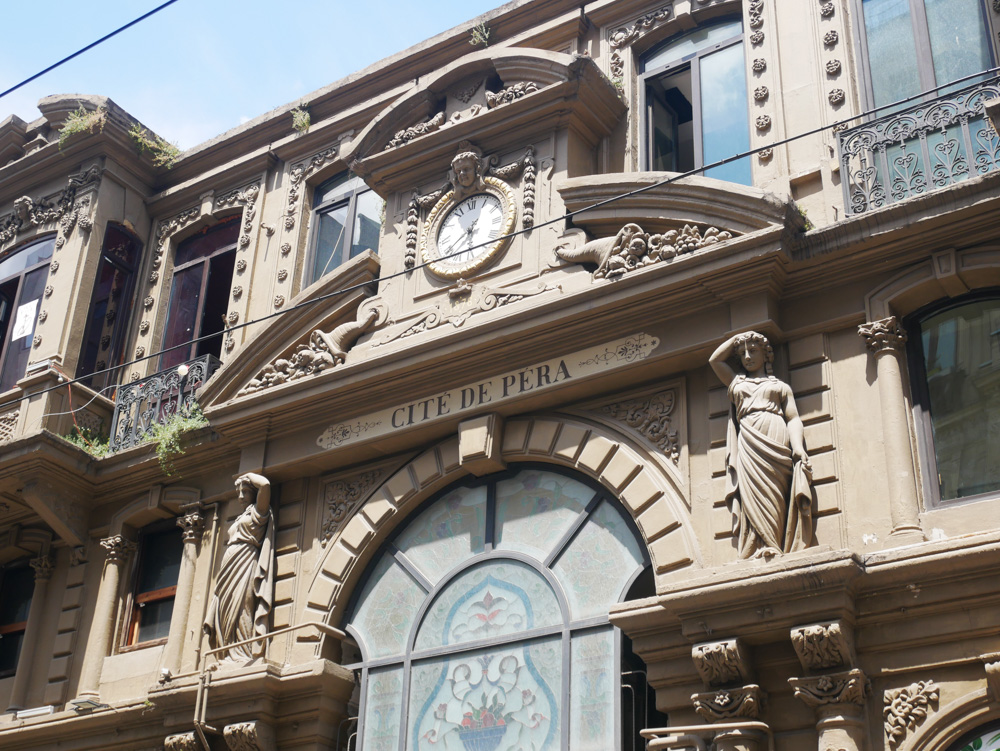
The ornate façade of the Cité de Péra, one of Beyoğlu’s elegant historic passages and a reminder of the district’s cosmopolitan European past.
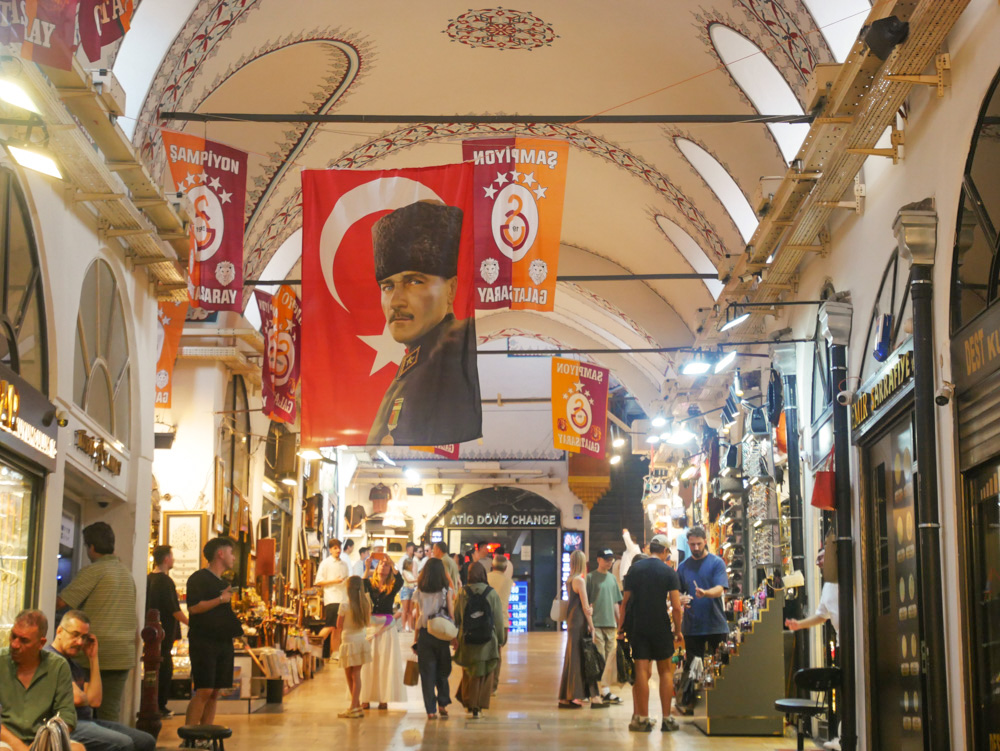
The lively arcades of Istanbul’s Grand Bazaar, beneath Ottoman vaults adorned with Turkish flags, a portrait of Mustafa Kemal Atatürk, and Galatasaray football banners.
Writers and travelers under Istanbul’s spell
For three centuries, Istanbul has been endlessly rediscovered by outsiders and insiders alike: diplomats and novelists, aristocratic women and modern wanderers, each leaving behind a different city in words. The voices gathered throughout this dedicated city guide span a remarkably diverse range of backgrounds, professions, cultures and eras, offering multiple glimpses of the city as it changed through time.
The earliest travel notes featured here date from the early 18th century, when Lady Mary Wortley Montagu (1689–1762), wife of the British ambassador, entered Ottoman female spaces largely inaccessible to European men; her Turkish Embassy Letters offer an unusually intimate portrait of hammams, dress, domestic rituals and elite society. Almost two centuries later, the French writer Marc Hélys (1864–1957) ventured into this same secluded world at the twilight of the empire, recording ceremonies, costumes and encounters behind palace walls in Le Jardin fermé.
Her contemporary Pierre Loti (1850–1923) turned his gaze instead to the city beyond those walls, returning repeatedly to its nocturnal waters, cafés, cemeteries and popular quarters, and mourning an old Ottoman Istanbul he feared modernity would erase. A younger, distinctly modern voice emerged with the American John Dos Passos (1896–1970), whose journey in the 1920s captured bazaars, carpet merchants, streets and crowds with a restless eye for movement, colour and the encounters between East and West. And finally, the perspective shifts from visitor to native chronicler with Abdülhak Şinasi Hisar (1887–1963), who transformed memories of yalis, gardens and changing waters into a poetic elegy for the vanished “Bosphorus civilisation” of his youth.
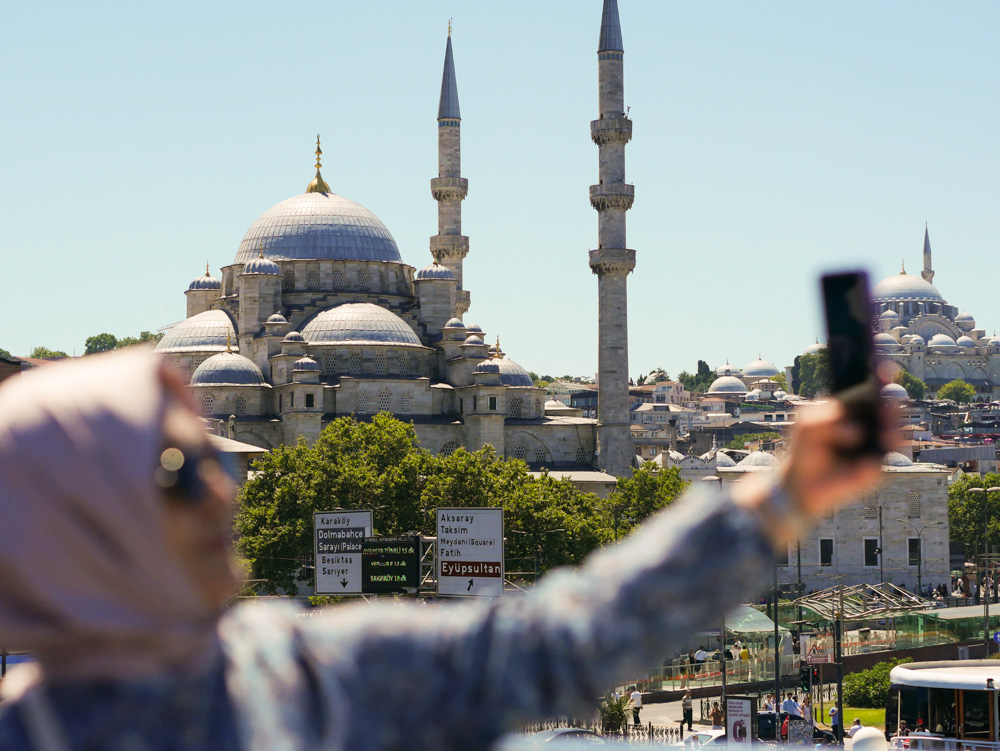
From one Istanbul to another
To feel Istanbul change character from one neighbourhood to the next, begin in Sultanahmet, where the great monuments of the imperial city rise almost within sight of one another. Walk between the domes of Hagia Sophia and the Blue Mosque, the courtyards of Topkapı and the ancient Hippodrome, then let the ceremonial city dissolve into the exhilarating disorder of the Grand Bazaar: vaulted passages alive with merchants’ voices, carpets, jewellery, ceramics and the warm gleam of copper. Here, Byzantine, Ottoman and mercantile Istanbul seem to overlap at every turn.
Cross the Golden Horn and another Istanbul takes over. Around Galata, Pera and Beyoğlu, steep streets climb from the waterfront towards elegant 19th-century façades, old European passages, churches, cafés and the former embassies of a city once intensely connected to the West. Follow İstiklal Avenue towards Taksim, wander into its side streets, then return towards the Galata Tower as evening falls, when restaurants and bars fill, music drifts through open doors and the old cosmopolitan quarter reveals its younger, more restless face.
Then take the ferry across the Bosphorus to Kadıköy, on the Asian shore, and allow the rhythm to change once more. Less monumental and more lived-in, its streets unfold around food markets, neighbourhood shops, cafés and busy restaurants, while the waterfront opens onto ferries, sea air and the distant silhouette of the European city. Stroll through the market, linger over a meal, then walk towards Moda: here Istanbul feels less like an imperial capital to be admired than a contemporary city simply going about its life.
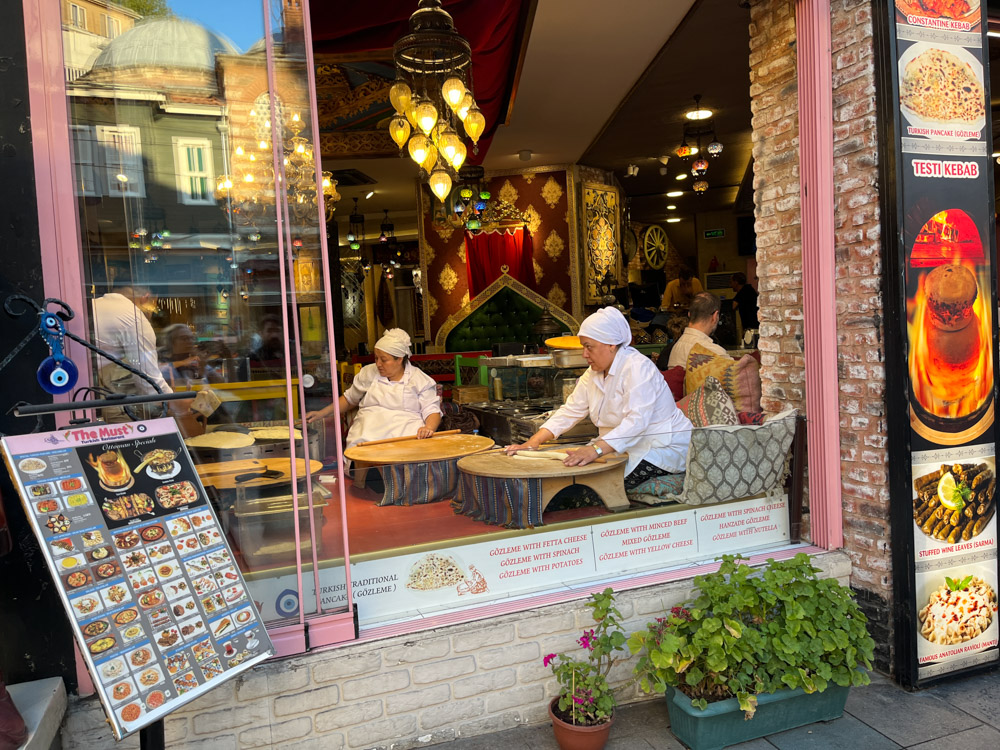
Women prepare gözleme by hand in the window of an Istanbul restaurant, rolling the dough in a familiar display of traditional Turkish cooking.
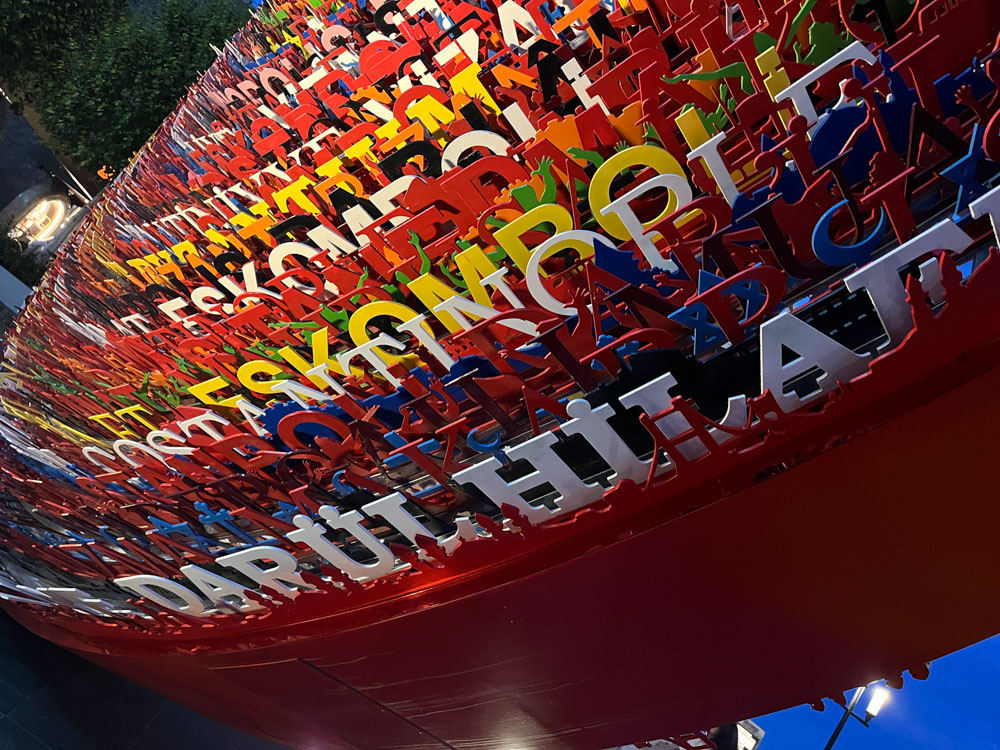
A striking contemporary installation at Istanbul Modern, where a dense cascade of colourful letters transforms language into a vibrant sculptural landscape.
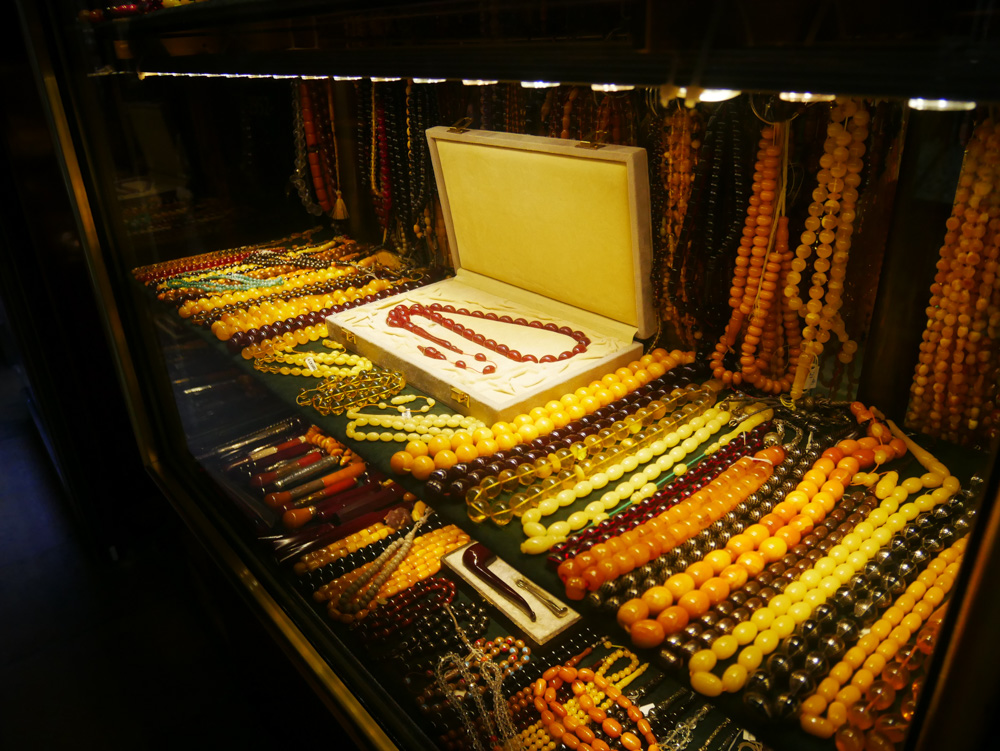
Strings of amber prayer beads fill a Grand Bazaar shop window, their warm shades ranging from golden honey to deep cognac.
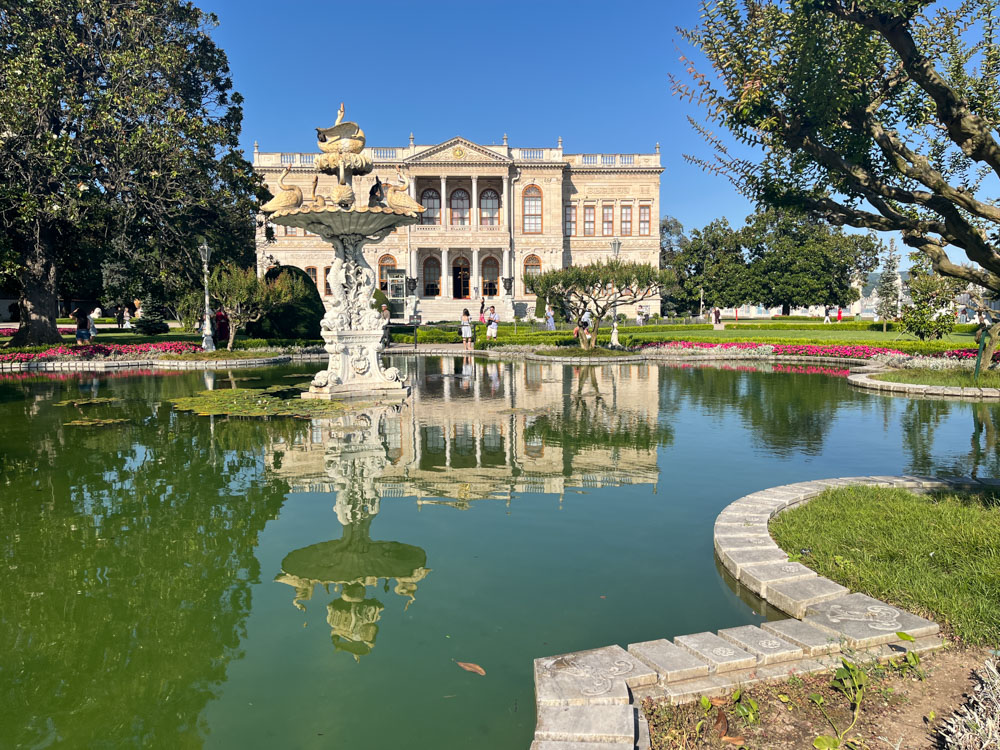
The elegant gardens of Dolmabahçe Palace, where an ornate fountain and tranquil pond reflect the palace’s magnificent 19th-century façade.
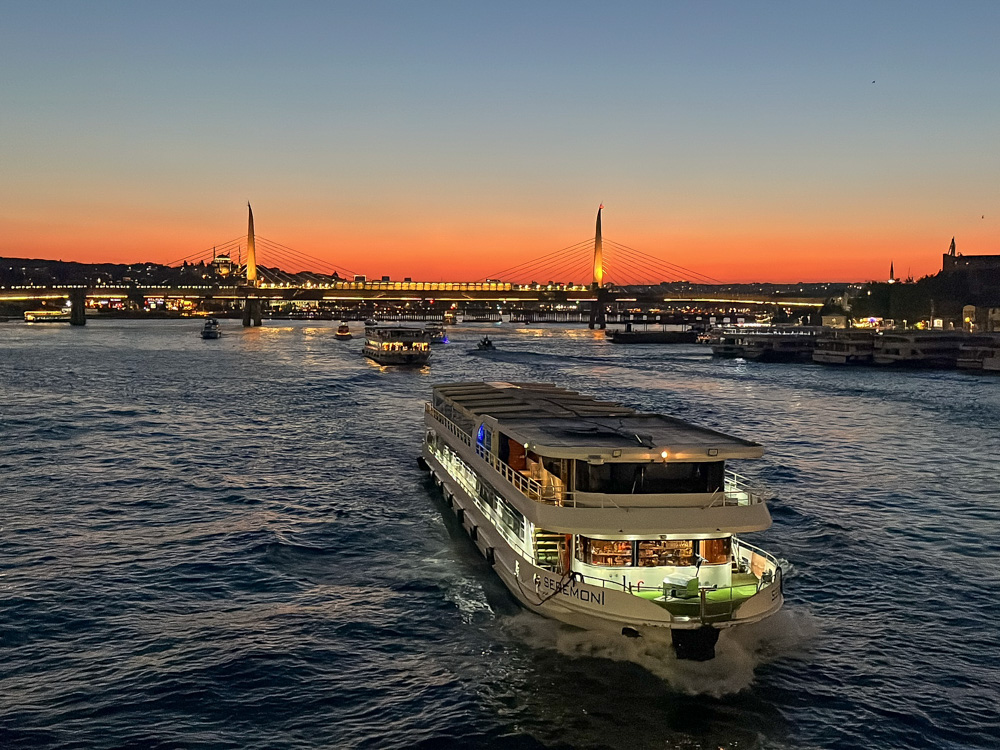
And when the day begins to fade, there is nowhere more magical to be than on the Bosphorus, the shimmering pearl of Istanbul. From the water, the city slowly unfolds like a dream: domes and minarets recede into the distance, palaces and wooden yalis glide past the shores, bridges stretch between continents and fishing boats disappear into the evening haze. Ship horns echo across the strait, gulls cry overhead and, from the hills, the voices of the muezzins drift across the salty air, mingling for a few suspended moments with the sounds of the water. Blue deepens into violet, the horizon blushes pink and gold, and lights begin to flicker along both Europe and Asia.
Somewhere between sea and sky, past and present, East and West, Istanbul seems to reveal itself most completely — elusive, theatrical and endlessly seductive. Step aboard, let the shores drift by, and allow the city to carry you into its spell.
Explore this fabulous city as it was lived and breathed by the talented authors gathered in these pages and, at the end of each article, discover our Citimap: a selection of our favourite places, chosen to bring you closer to the true soul of Istanbul.
The Istanbul Guide is dedicated to my dear friend Charis, thanks to whom I found the ideal setting in which to bring these travel notes to life.
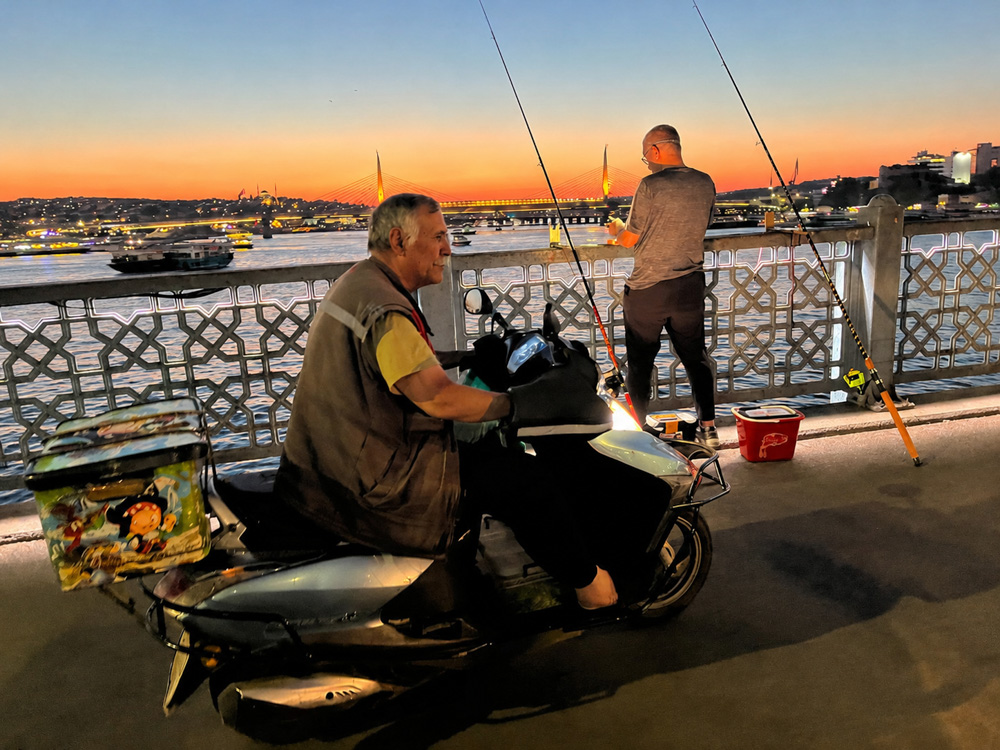
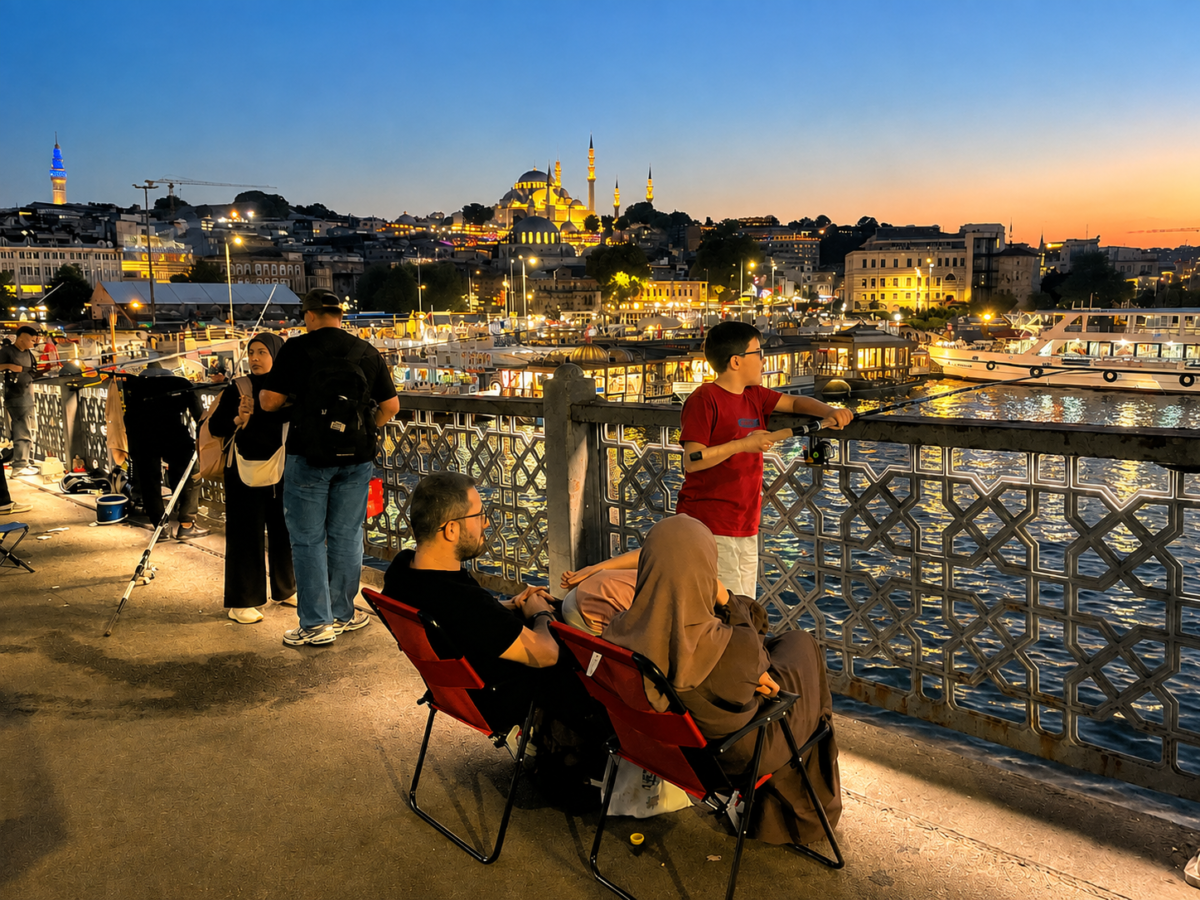
Evening on Galata Bridge, where locals fish and linger above the Golden Horn as the illuminated Süleymaniye Mosque rises over Istanbul’s historic skyline.
Citinotes