citinotes
Sultans, Harems and Palaces
Ottoman Istanbul — then known as Constantinople — was a city of palaces, beginning with Mehmed II’s imperial complexes following the conquest of 1453, most famously Topkapi Palace at Sarayburnu. Alongside the Sultan’s residences, princes, princesses, high officials and wealthy families maintained their own palaces, mansions and waterfront yalis, elegant houses lining the shores of the Bosphorus.
From the 17th century onward, the Bosphorus increasingly became a favoured setting for imperial residences, gardens and pleasure pavilions. Despite their great variety, these residences typically distinguished ceremonial and male reception spaces from private family quarters, often arranged around halls, gardens and courtyards.
By the 19th century, Ottoman interiors increasingly blended traditional layouts and decoration with European Baroque, Rococo and Neoclassical influences, featuring sumptuous textiles, chandeliers, porcelain and imported furniture, as seen in palaces still famous today, such as Dolmabahçe and Beylerbeyi.
These palaces provided an exquisite setting for the most important ceremonies of the year: the Iftar ritual, the Bayram celebrations and, of course, countless sumptuous dinners beneath extravagant chandeliers, surrounded by porcelain centrepieces and precious silverware. Our selected travel notes were penned by privileged visitors who were granted the rare opportunity to attend these highly exclusive ceremonies and gatherings at the imperial court and in the grand mansions of the Ottoman elite.
In the first chapter, French writer Marc Hélys takes the reader inside an affluent Ottoman household, describing the rituals surrounding the evening Iftar. Iftar is the meal that breaks the daily fast at sunset during Ramadan, a practice rooted in the earliest years of Islam and traditionally begun with dates and water, following the example of the Prophet Muhammad. In ordinary Ottoman households, it was above all a family meal, enriched by the important custom of welcoming relatives, neighbors and strangers.
In the imperial palace and elite mansions, however, iftar developed into an elaborate courtly ritual. Lavish tables, precious tableware and numerous dishes reflected the splendor of the household, while seating and service followed established hierarchies. Palace hospitality also extended beyond the elite: food, gifts and sometimes money were distributed to servants, dependants and the poor. Iftar thus became both a religious observance and a public expression of Ottoman generosity, prestige and power.
In the second chapter, the same author offers a vivid glimpse into a fading world of Ottoman domestic life, where traditional costumes, music and dances coexist with the increasingly Westernised manners of Constantinople’s elite. Her attention gradually shifts to the household eunuch, whom she portrays not simply as a guardian of the harem, but as a complex and unexpectedly sentimental figure.
The institution of eunuchs long predated Islam, appearing in ancient Mesopotamia, Persia, China and Byzantium before becoming important in several Islamic courts. In the Ottoman Empire, eunuchs were enslaved men, castrated before entering imperial or elite households; many came from Africa, and others, particularly earlier, from the Caucasus or Europe. Their inability to father children was considered essential for service in spaces where access to women was strictly controlled.
Eunuchs lived within or beside the households they served and were also employed, on a smaller scale, by wealthy families. The Chief Black Eunuch (Kızlar Ağası) could become one of the most powerful figures at court, controlling access, communications and important religious endowments. Their relationship with women could extend far beyond guarding and service: they became confidants, intermediaries, protectors and sometimes almost family members. The institution declined with slavery and disappeared following the dissolution of the imperial harem and the Ottoman dynasty’s exile in 1924.
In the third chapter, we keep following Hély’s footsteps into the fascinating world of the Ottoman elite. This time, she takes us to a Bayram ceremony in the monumental throne room at the heart of the extravagant Dolmabahçe Palace, the Sultan’s principal residence in the 19th century. At the imperial court, Bayram, marking the end of the month-long Ramadan fast, was not merely a family celebration but one of the great ceremonies of state, governed by a highly codified protocol dating back at least to Mehmed II.
At Topkapi Palace, the Sultan appeared in magnificent ceremonial dress and received the homage of princes, the Grand Vizier, palace officers, religious dignitaries and military commanders, each approaching according to rank. Some kissed his hand, others the hem of his robe, turning the ceremony into a ritual affirmation of allegiance. In the 19th century, Bayram acquired a more European courtly appearance. At Dolmabahçe, officials paid homage to the Sultan seated on the golden throne in the great Ceremonial Hall, while a separate celebration brought together the Sultan and the women of the imperial household in the Harem’s Blue Hall. In Hély’s account, religious, ritual, military splendour and European influences converge. Her description is particularly striking for the contrast between the Sultan’s solemn figure and the glittering spectacle surrounding him.
Marc Hélys (1864–1958), the pen name of Marie Léra, was a French journalist, writer, translator and traveller with a particular interest in the lives and status of women abroad. Her work combined travel writing and social observation with an early interest in feminism, often exploring worlds largely inaccessible to male travellers. During several stays in Constantinople in the early 20th century, her friendships with Ottoman women gave her rare access to their homes and private social circles. These experiences inspired Le Jardin fermé, a collection of vivid scenes of women’s lives in late Ottoman Turkey, from harems and domestic gatherings to Ramadan celebrations and changing social customs.
Further on, we explore a rare 18th-century account of a sumptuous Ottoman banquet through the eyes of an ambassador’s wife.
Lady Mary Wortley Montagu (1689–1762) was an English aristocrat, writer and poet, celebrated for her intelligence, independence and sharply observant correspondence. She lived in Constantinople in 1717–1718 while her husband served as British ambassador, gaining rare access, as a European woman, to Ottoman homes, baths and female society. In The Turkish Embassy Letters, Montagu recorded her experiences of the Ottoman Empire with an unusually curious and often sympathetic eye. The selected passage comes from a letter dated March 10, 1718, recounting a banquet at the home of Hafiz Ahmed Pasha, a favourite of the former Sultan Mustafa II. Montagu marvels at the extraordinary luxury of the Ottoman meal, from gold cutlery and silk napkins to sherbet served in porcelain and gold. The meal would traditionally have been arranged around a sofra, a low table or dining spread around which diners gathered, making her description a vivid glimpse into elite Ottoman hospitality and dining customs.
Last but not least, we enter the secretive world of an imperial harem through the travel notes of another French woman of letters. Far from being merely a space of sexual pleasure, the imperial harem was a highly organised household and an important centre of dynastic and political power. In the Ottoman palace, it housed the Sultan’s mother (Valide Sultan), wives and consorts, daughters, female relatives, servants and enslaved women, and was governed internally by the Valide Sultan according to a strict hierarchy. Daily life combined education, music, embroidery, religious observance and entertainment. The Sultan enjoyed privileged access, although his encounters and domestic life were governed by court protocol. Access for other men was extremely restricted, with Black Eunuchs guarding the entrances, while women of the dynasty and selected female guests could visit. The women of the harem also took part in family visits, excursions and ceremonies under prescribed conditions.
Comtesse Dash (1804–1872), the pen name of Anna Gabrielle de Cisternes de Courtiras, was a prolific French novelist, particularly known for novels of manners and historical fiction portraying the romances, intrigues and scandals of 19th-century aristocratic society. In Constantinople, she encountered Ottoman domestic life from the unusual perspective of a European woman admitted into private female spaces. Her account of a visit to a harem in Scutari, today’s Üsküdar, vividly captures the mutual curiosity between Ottoman and European women, turning questions of dress, beauty and social customs into a lively encounter between two worlds.
To step into Istanbul’s palaces is to journey through three different chapters of the Ottoman world. At Topkapi, wander through courtyards, treasury rooms and the intimate maze of the Harem, where centuries of imperial power unfolded. At Dolmabahçe, surrender to the dazzling excess of the 19th-century court, amid monumental halls, crystal chandeliers and gilded decoration overlooking the Bosphorus. Cross to the Asian shore for Beylerbeyi, where a more intimate summer palace, elegant gardens and waterside pavilions reveal the refined pleasures of imperial life on the Bosphorus.
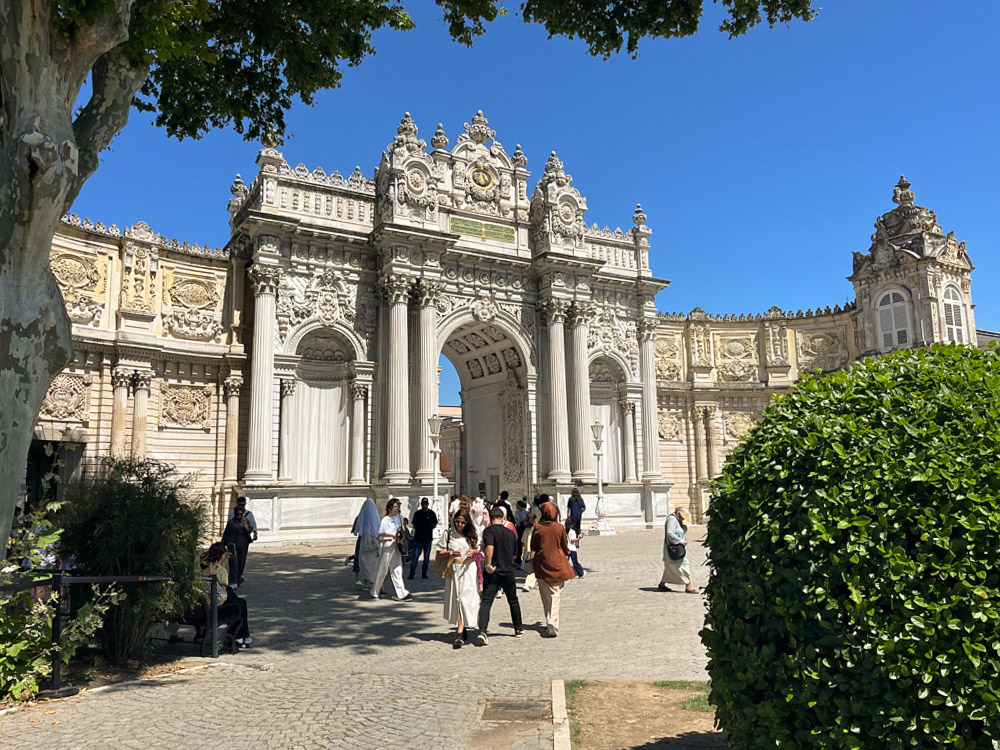
The magnificent ceremonial entrance to Dolmabahçe Palace, an exuberant display of 19th-century Ottoman architecture.
Citinotes
chapter 1
Silver, silk and Ramadan
During Ramadan, the cannon shot that rings out at the precise moment of sunset announces the hour when all famished Constantinople sits down to table. The final hour of the fast seems endless.
In every home, rich or poor, supper—the iftar—is prepared. Its luxury lies above all in the abundance of sweets and preserves. It is an occasion for family gatherings, when male relatives—uncles, cousins, nephews—are admitted into the innermost apartments of even the strictest harems.
In principle, during Ramadan, every Muslim household opens its doors at the hour of iftar to the poor and to unknown passers-by.
Officials are expected, at least once during the month, to take iftar at the Palace, where they are received either by the First Chamberlain or by the Grand Master of the Offices, both of whom keep open table. On such occasions, each guest receives a gift of between five and twenty Turkish pounds. In former times, indeed, Oriental hospitality required that every guest be presented with a silver coin, as a pledge of his return. The custom, long since abandoned in private households, has been preserved at the Palace.
Women invite one another to supper. Ramadan is the only time of year when they are permitted to go out after sunset, and they make full use of this freedom. An elegant lady of Stamboul scarcely sups at home more than two or three times during that blessed month.
My stay in Stamboul beneath the hospitable roof of Fahimé Hanum gave me the opportunity to discover one of the most sumptuous interiors in Constantinople: the home of the daughter of the city’s governor, where we had been invited to take iftar.
Melek Hanum was a young woman much beloved in Turkish society for her kindness and charity. Dressed in a mandarin-style evening gown embroidered with silver and trimmed with lace, she received her guests in drawing rooms filled with Saxon figurines and inspired by our eighteenth century, with soft lampas fabrics and pale woodwork wreathed in garlands.
The supper table glittered with silverware, flowers and countless ornaments. Sèvres biscuit nymphs, dancing upon a lake of ice, formed the centrepiece. Night-lights glowed softly within pink lotus flowers, while Bohemian crystal swans carried salted and peppered almonds between their wings. Every refinement that French or English fashion had invented over the previous ten years seemed to have found its way onto this Turkish table, while the guests were served by slaves in flowing gowns of pale blue silk.
In the salon, the evening that followed resembled any fashionable gathering elsewhere in Europe. The daughters of the Grand Vizier, fresh as figures from a keepsake album, conversed in English with an Englishwoman. Music was played; the daughters of another great personage sang airs by Chaminade and melodies of their own composition, set to poems by Mlle Vacaresco. A young woman recited La Nuit d’octobre.
What, then, remained Oriental in these young women? And yet, on looking more closely, the Orient revealed itself: in the pearly delicacy of complexions sheltered by an eternal veil from the harshness of the air; in the elongated eyes inherited from Circassian ancestors; even in the profusion of smiling grace with which these friends treated one another; and, above all, in the quicksilver mobility of their emotions.
With equal ardour and sincerity, they passed from seriousness and melancholy to childishness and effortless joy—from La Nuit d’octobre to the dances of the almées.
Marc Hélys, Le Jardin fermé, Calmann-Lévy, 1907
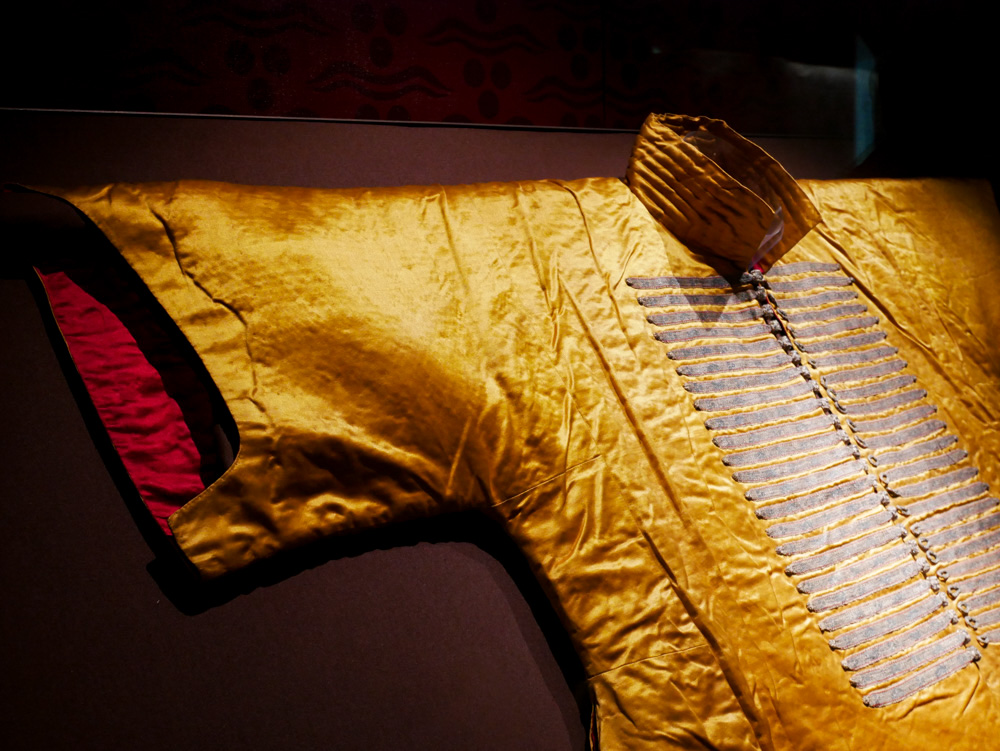
A sumptuous golden Ottoman kaftan, its restrained design enlivened by an elaborate silver-braided front.
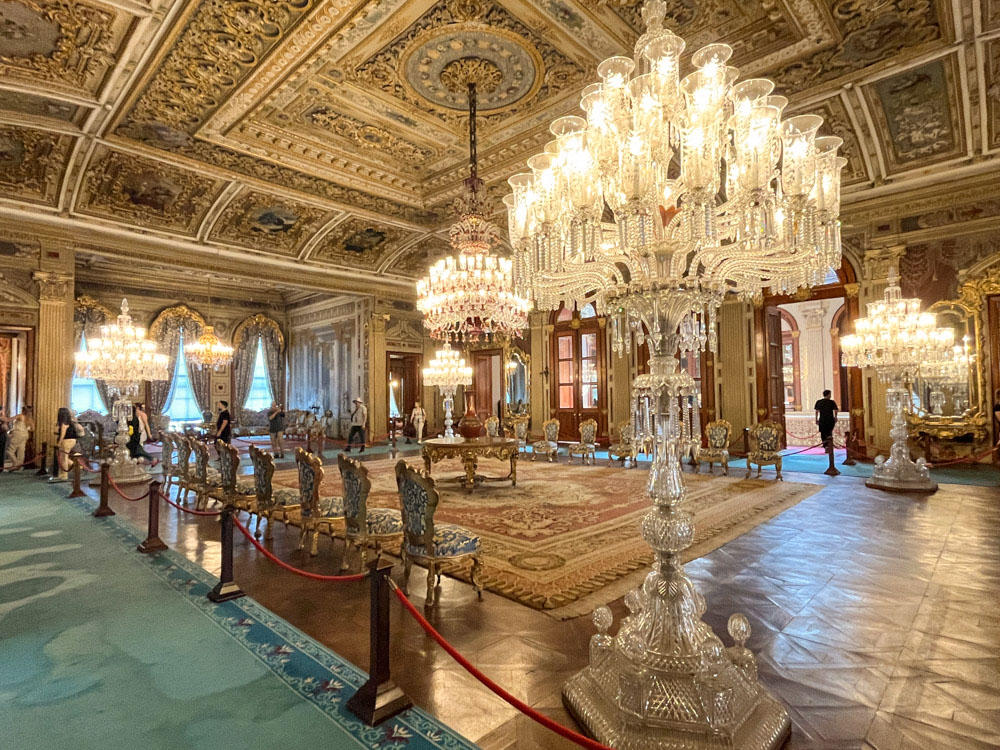
The sumptuous interiors of Dolmabahçe Palace, where enormous crystal chandeliers, gilded furniture and elaborate ceilings evoke the dazzling world of the late Ottoman court.
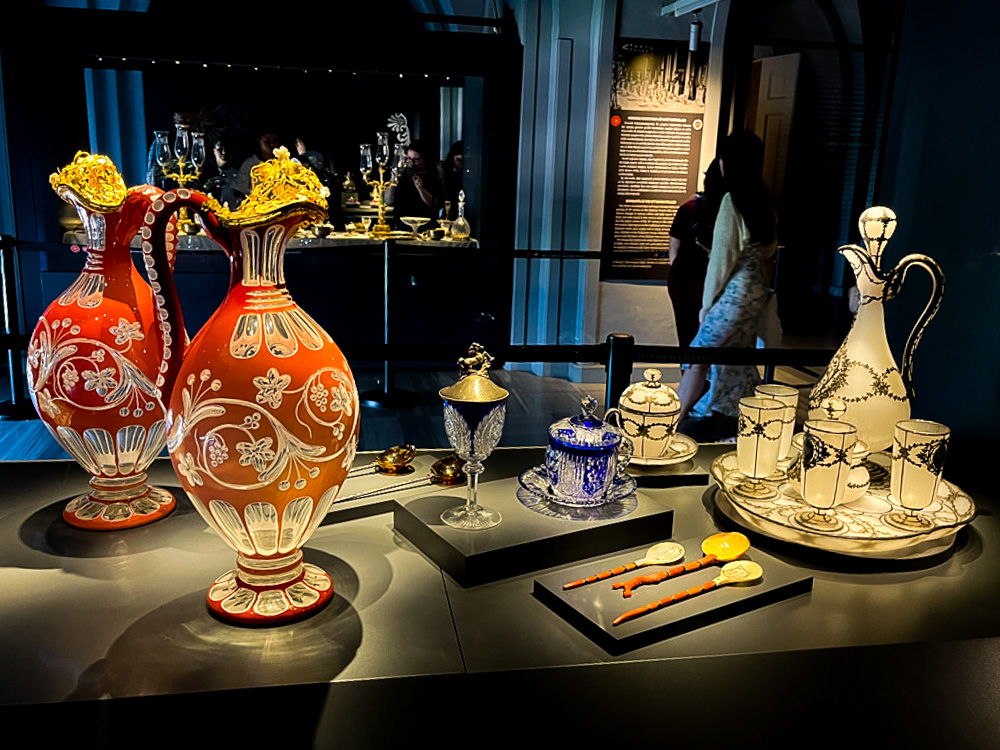
Treasures from Dolmabahçe Palace, including richly decorated glassware and elegant objects from the Ottoman imperial collections.
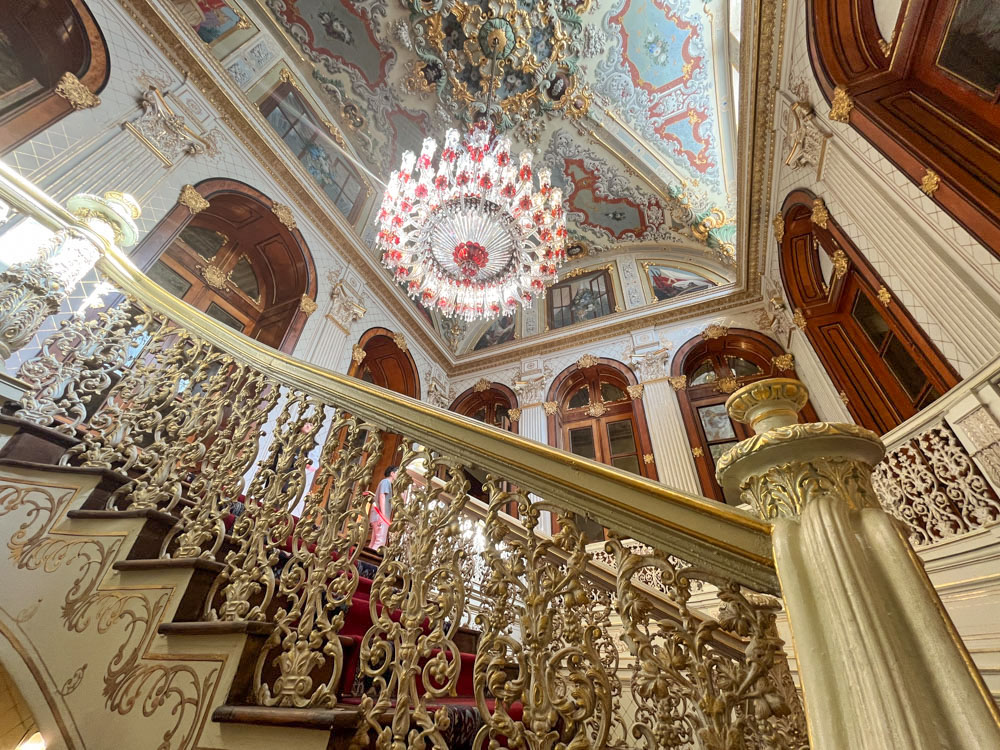
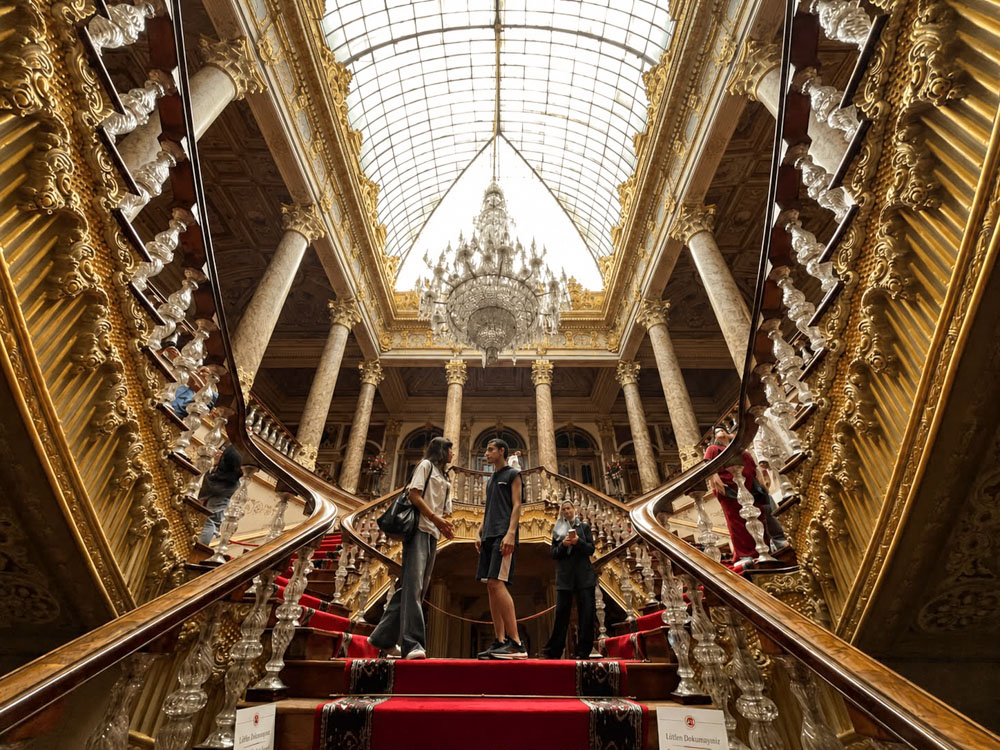
A lavish palace staircase beneath a glittering crystal chandelier and richly painted ceiling, epitomising Dolmabahçe’s European-inspired splendour.
chapter 2
The Last Eunuch of the Harem
These dances were performed by young girls for whom Turkish costumes from the good old days had been brought out: chalvars and gowns with long trains, forgotten in their grandmothers’ chests and now so rare that collectors paid extravagant prices for them. They were fashioned from faded satins in subtle, distant colours and covered with heavy embroidery in fine gold. […]
Wearing a little cap of bright velvet and a floating jacket embroidered with silver, her lute tucked beneath her arm, the rosy young girl with laughing eyes was a charming sight as she amused herself by miming for us a “classic scene of Oriental life.”
To these playful scenes, the eunuch, correct and elegant as the most fashionable boulevardier, lent the approval of a dazzling white smile against his dark face. In an impeccably cut iron-grey suit, with diamonds and pearls glittering at his tie and on his fingers, he produced a strange and sombre effect among the women, mistresses and slaves alike, whose guardian he was and who did everything they could to spoil him.
By then, a eunuch had become a rare luxury in Constantinople. Women regarded these ambiguous and troubling figures with aversion.
And yet, in some of these unfortunate men, the natural attraction towards women, rather than turning bitter and hardening into hatred, was transformed over the years into a feeling composed of longing, protectiveness and even tenderness. Some married simply to have a feminine presence beside them; others adopted and cherished the daughters of their friends. I knew a sweet little girl who, until her marriage, was pampered to her heart’s content by the chief eunuch of a princess. When the carefully tended flower became the ornament of another garden, the old eunuch was left deeply saddened.
Melek Hanum’s eunuch was treated with every consideration by his mistress’s friends, and in return he smiled upon them graciously. He was a sentimental soul whom thwarted love had not made savage. Every day he begged the young woman to find him a wife who was “white, fair-haired and beautiful.” He collected photographs of pretty women and, at that time, was madly in love with one of the beauties of the foreign colony, whom he had glimpsed at the social gatherings to which he escorted his mistress.
Marc Hélys, Le Jardin fermé, Calmann-Lévy, 1907
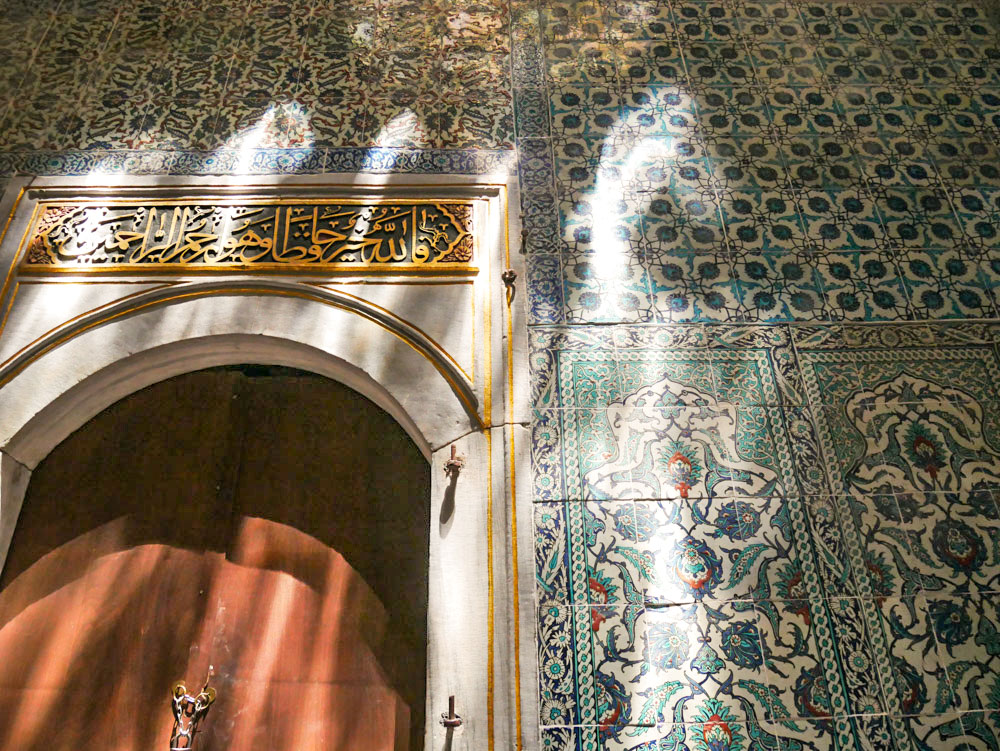
Sunlight falls across exquisite İznik tiles and Ottoman calligraphy in one of Topkapı Palace’s richly decorated chambers.
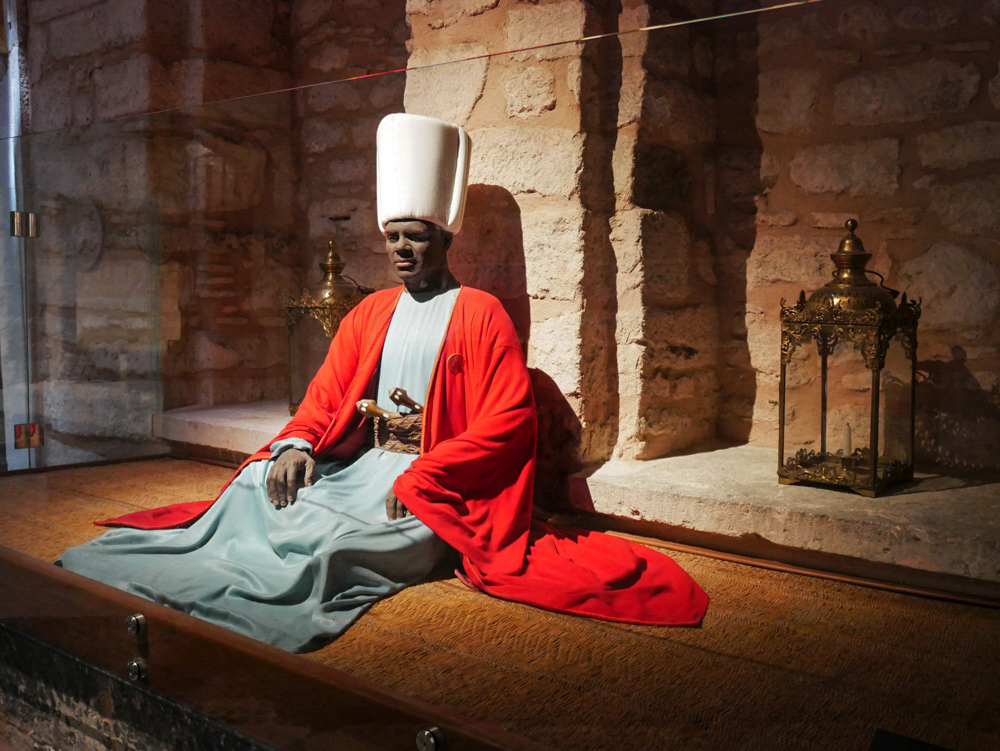
A Black Eunuch of the Imperial Harem, whose members guarded and administered the secluded world of the Sultan’s household at Topkapı Palace.
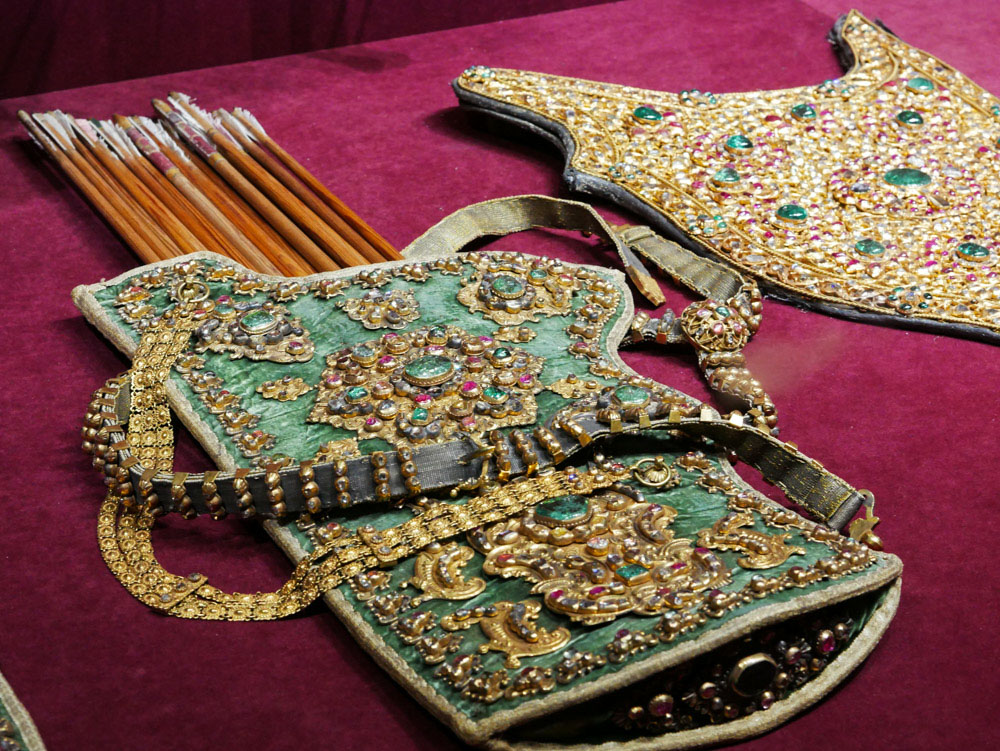
Lavishly decorated Ottoman archery equipment, embellished with gold and precious stones and reflecting the prestige of archery at the imperial court.
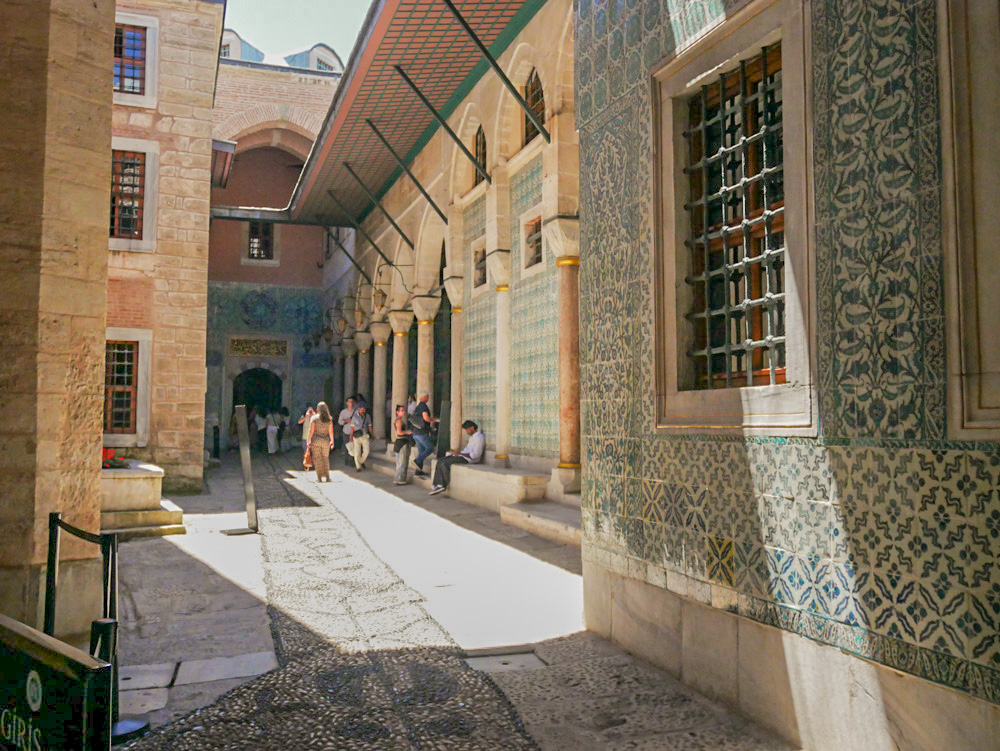
A sunlit passage through the Harem quarters of Topkapı Palace, its walls richly covered with intricate blue-and-white İznik tiles.
chapter 3
Bayram at the Sultan’s Palace
Cannon shots ringing through the night announce Bayram, the solemn close of Ramadan. News has arrived from Bursa that the moon has reappeared. It had been awaited since the previous evening, for it is not enough that the heavenly body should, scientifically and mathematically, be in its appointed place: good Muslims must also have seen it there, and no troublesome mist must have stolen the pale silver crescent from the celebrations awaiting it.
The night of Bayram is a great night, and little sleep is had in Stamboul. One hears the dull rumble of cannon and the measured tread of marching troops.
The highest religious, civil and military officials prepare their finest uniforms, for at daybreak they must escort the Sultan to the palace of Dolma-Bagtché and attend, in the mosque, the prayer preceding the ceremony of the kissing of the hand.
At the Sublime Porte, all is commotion over the countless details to be settled with the embassy dragomans; and the foreign woman who, like myself, has obtained by special favour admission to the diplomatic gallery can scarcely sleep either, for fear of missing some part of the imposing ceremony.
First, at dawn, comes the enchanted vision of the white palace, appearing at last behind gates that are always closed. Immense and fantastic, it rises in a profusion of columns, arcades and terraces, separated from the green waters by delicate railings cut into festoons. It stands there, gleaming white amid cedars and flowering lawns. Dazzling and baroque, it is a chaos of incongruous forms.
Yet in that fluid golden light, beneath the green reflection rising from the water and the rosy glow descending from the sky, the marble shimmers and changes colour. The atmosphere envelops it in softness and harmony, and from the palace’s very incoherence a strange beauty emerges.
A magnificent military display surrounds it. These are the fine troops admired on the days of the Selamlik, now massed along the sovereign’s route. They had formed a guard of honour that morning when, at daybreak, the Sultan descended from Yildiz Kiosk to the mosque.
The only foreigners admitted to the ceremony are members of the diplomatic corps and the officers of the station ships. Occasionally, an embassy obtains the same privilege for one of its nationals passing through the city.
The Europeans are first gathered in a drawing room, from which an aide-de-camp conducts them to the diplomatic gallery occupying one side of the throne room. Towards them, the Turks display their gracious hospitality in the form of a well-stocked buffet, where a samovar smokes amid mountains of cakes.
The throne room of Dolma-Bagtché is the largest in Europe. Its proportions are magnificent, though its decoration, the work of Italian artists, is ugly and vulgar. Yet the overall effect remains imposing, owing to the sheer scale of the hall and its almost absolute bareness. At one end stands the Sultan’s very simple throne, without steps or canopy, between colossal candelabra.
At first empty, the hall gradually filled before our eyes, in complete silence. Long files of richly embroidered dignitaries, soldiers in splendid uniforms, imams and hodjas in green, grey or blue robes entered, formed ranks, and silently slipped past one another to their appointed places. Behind the throne stood the princes; closer to the imperial seat gathered the ministers, secretaries and chamberlains.
There followed a long interval of silence and immobility. Then the Palace band struck up the Hamidié March, and amid all that brilliance and splendour appeared a man with sorrowful eyes, dressed in the simple greatcoat of a soldier. It was the Sultan.
The sovereign stopped. The cadi of Stamboul came forward to receive him and invited him to a brief prayer, which they performed together with raised hands. The Sultan then reached his throne, and the ceremony of the kissing of the hand began.
First the princes, then the Grand Vizier, the ministers, members of the Sultan’s household, the pashas, lallahs and mollahs approached one by one, while the sovereign, standing, received their homage. Each performed the Oriental salute, placing his hand first upon his heart and then upon his forehead, before making the gesture of kissing the insignia held by a richly adorned personage standing beside the sovereign.
I was told that this emblem, which from afar resembled a kind of stole, symbolised the horse-tails, emblems of authority once planted as standards before the tents of chiefs in the great days of Islamic conquest. Then the Sultan seated himself upon his throne while his soldiers filed past.
Suddenly, the orchestra launched passionately into Chopin’s great Polonaise.
At that very moment, a triumphant shaft of sunlight entered through a high window and struck the naked scimitar held in the Sultan’s fist. A flash sprang from the blade. In that instant, the true meaning of the ceremony seemed to reveal itself to me. That glittering blade was Islam and conquest.
The Polonaise, sounding furiously, stirred above the gilded crowd all the memories gathered by Chopin in the solitude of the steppes. […] The Sultan, impassive and perhaps unconsciously, made the blade glitter in the sunlight. I was still admiring the evocative art of these Turks when the “March from Tannhäuser” shattered that harmony of impressions.
Suddenly, a profound silence descended upon the hall, where thousands of hearts were beating, thousands of souls thinking and perhaps remembering. Then a great cry rang out, hurled by powerful voices: “Sultan, remember that you are nothing before the greatness of Allah!”
Slowly, dressed entirely in white, the Sheikh-ul-Islam advanced, accompanied by the Sherif of Mecca, clothed all in green. The Sultan rose and went to meet him. A few paces apart, they stopped. The Sheikh-ul-Islam raised his pale hands and gave the signal for prayer. The Sultan followed his example, and so did the many-coloured multitude. Thousands of hands reached towards heaven.
In three steps, the Sultan returned to his throne, and the head of religion kissed the armed hand, protector of the Faith. Then the cadis, the ulemas and the hodjas came forward in their turn.
From my place high in the diplomatic gallery, the Sultan appeared pale and sorrowful; yet, as he received the homage of his subjects, his bearing was truly that of a sovereign conscious of the full extent of his power. We realised that the ceremony had come to an end when we saw him swiftly withdraw.
A glittering, golden crowd, sparkling with decorations and ablaze beneath the gleam of ceremonial arms, filled the approaches to the Palace, the small park and the courtyards through which one had to pass before reaching the gates. All the great dignitaries of the Empire were present, together with the commanders of the army in their magnificent uniforms.
It was midday, and from that vision of splendour I carried away its radiance in my memory.
Marc Hélys, Le Jardin fermé, Calmann-Lévy, 1907
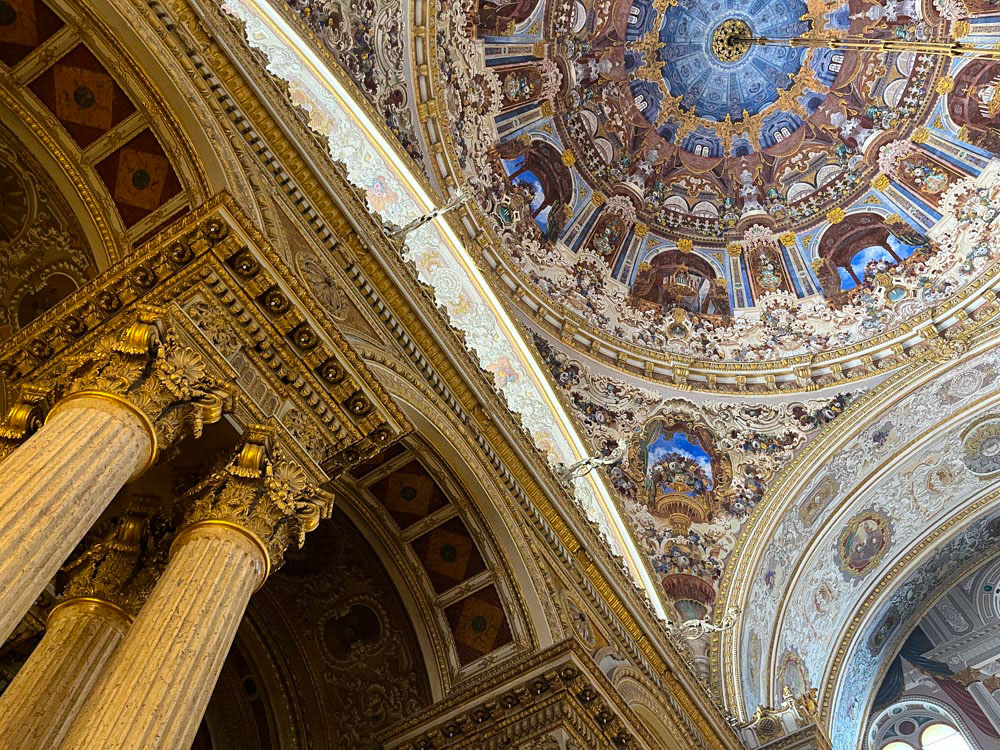
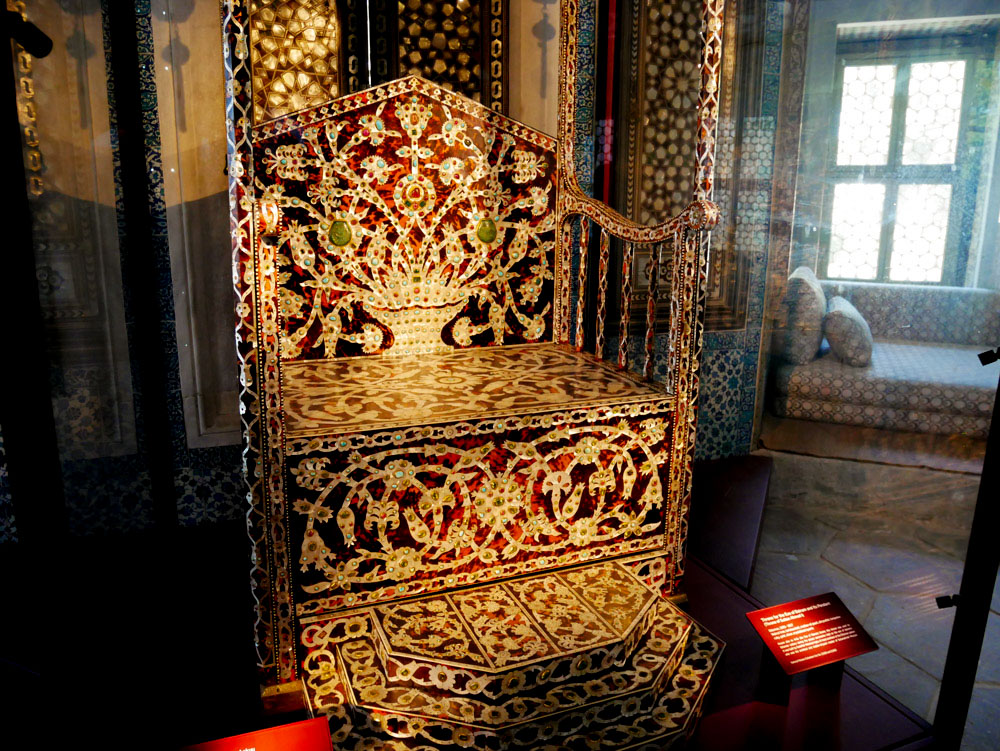
An extraordinarily ornate Ottoman throne from the Topkapı Palace Treasury, covered with mother-of-pearl, precious stones and intricate decoration.
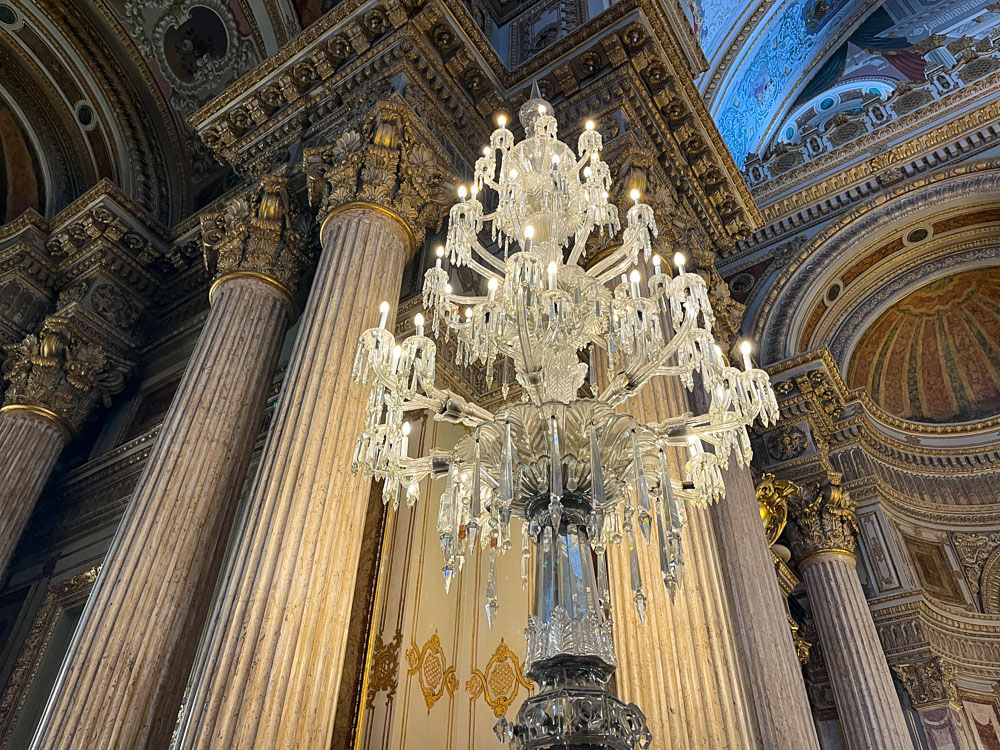
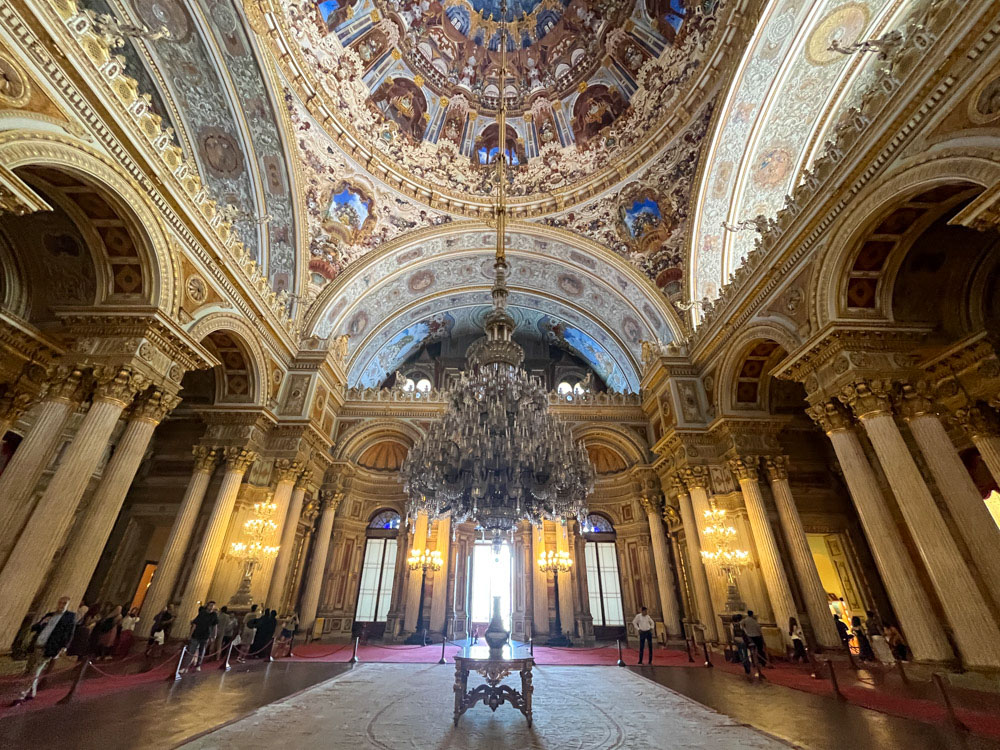
The vast Ceremonial Hall of Dolmabahçe Palace, crowned by its monumental crystal chandelier and richly decorated dome.
chapter 4
Fifty Courses with Golden Cutlery
She gave me a dinner of fifty dishes of meat, which (after their fashion) were placed on the table but one at a time, and was extremely tedious. But the magnificence of her table answered very well to that of her dress.
The knives were of gold, and the hafts set with diamonds. But the piece of luxury which grieved my eyes, was the table-cloth and napkins, which were all tiffany embroidered with silk and gold, in the finest manner, in natural flowers. It was with the utmost regret that I made use of these costly napkins, which were as finely wrought as the finest handkerchiefs that ever came out of this country.
You may be sure that they were entirely spoiled before dinner was over.
The sherbet (which is the liquor they drink at meals) was served in china bowls; but the covers and salvers massy gold. After dinner, water was brought in gold basons, and towels of the same kind with the napkins, which I very unwillingly wiped my hands upon, and coffee was served in china with gold soucoups (saucers).
Lady Mary Wortley Montagu, The Turkish Embassy Letters, T. Becket and P. A. De Hondt, London, 1763
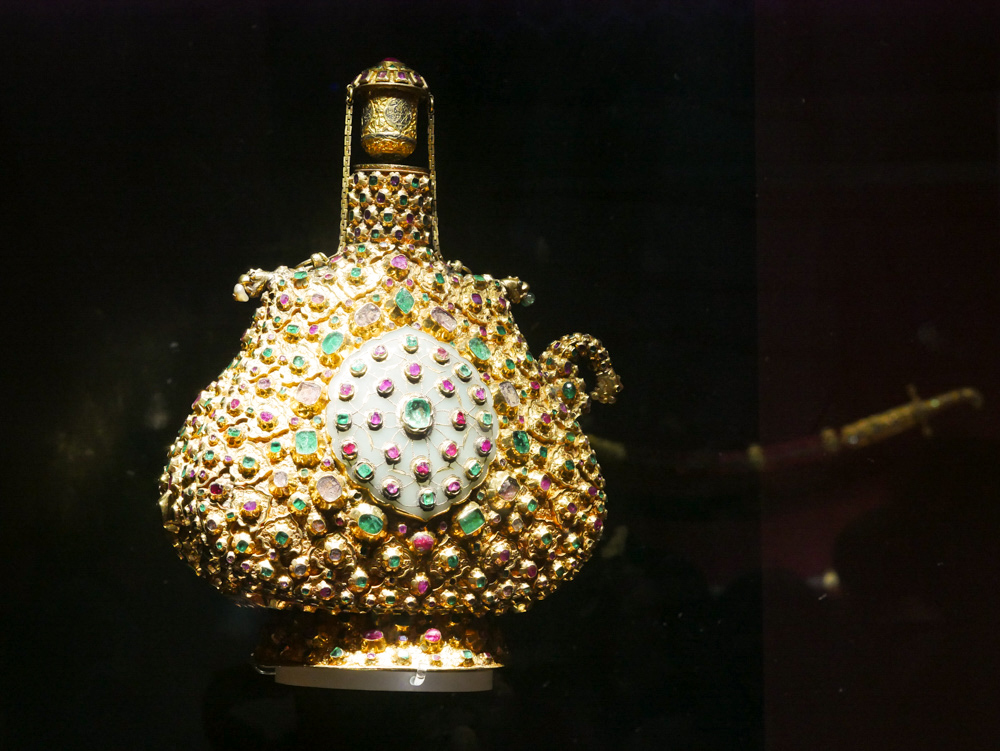
A jewel-encrusted imperial flask from the Topkapı Palace Treasury, glittering with emeralds, rubies and other precious stones.
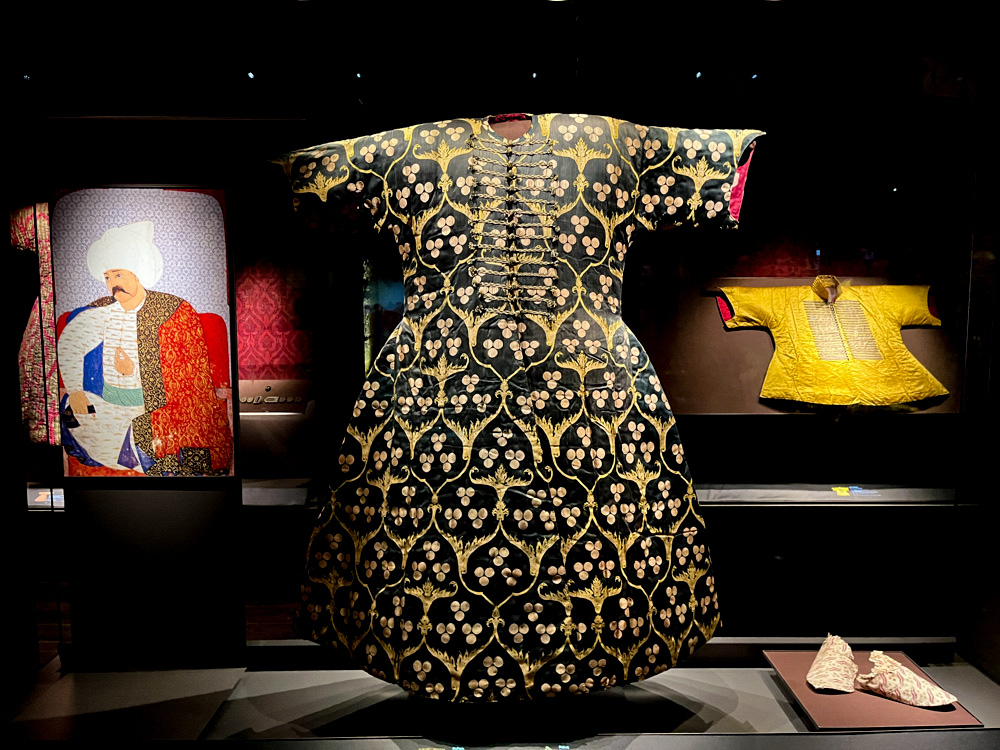
Magnificent Ottoman imperial kaftans displayed in the Topkapı Palace collections, richly woven with floral and metallic decoration.
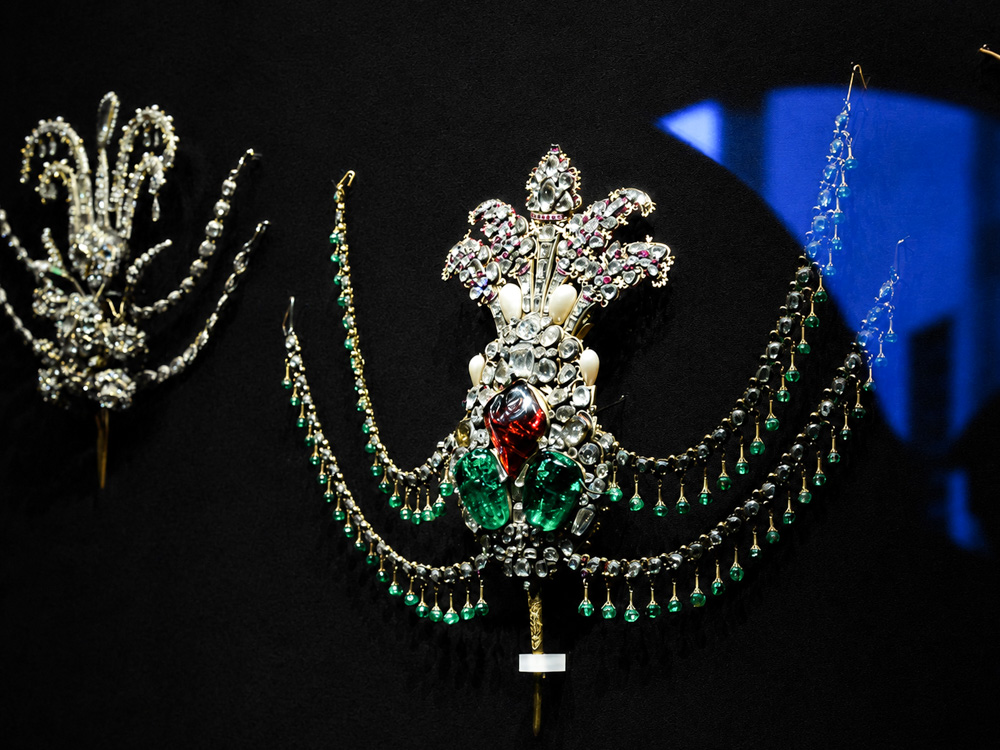
A dazzling Ottoman aigrette from the Topkapı Palace Treasury, encrusted with diamonds, emeralds, rubies and other precious stones.
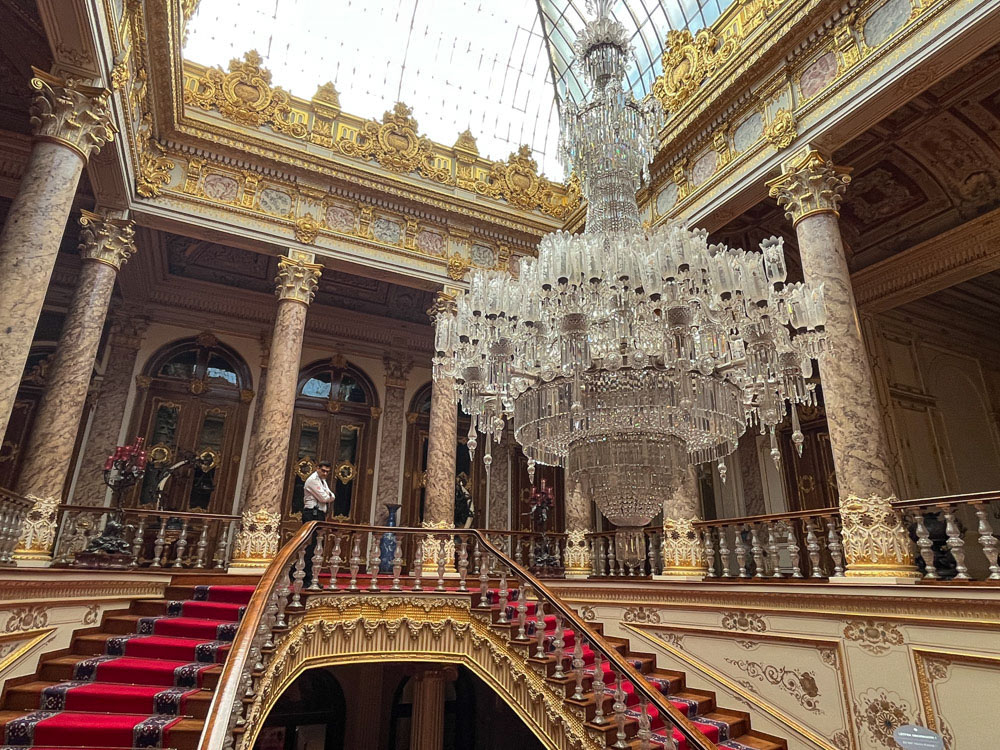
The spectacular Crystal Staircase of Dolmabahçe Palace, crowned by a glass dome and chandelier and framed by gilded decoration and crystal balustrades.
chapter 5
A Lady in the Harem
The hour of dinner was approaching—or rather, what we should have called luncheon. I did not join the family at table, having asked to take my meal separately, according to my usual habits. The ladies went through all the ceremonious courtesies of taking leave. In the East, politeness is carried to remarkable lengths. At last, they withdrew.
The day’s programme was to include nothing more than a walk through Scutari (today’s Üsküdar) with Ehminch and Fathma. I had been eagerly looking forward to it and was making ready when an unfamiliar commotion arose in the courtyard.
We hurried to the window, but the heavy grilles prevented us from seeing anything. Those bars were beginning to try my patience, yet there was no question of opening them. We caught only the faintest glimpse of movement below. The Greek woman, accustomed to such customs, said at once:
“We are about to receive a visit from another harem.”
“So the ladies visit one another?”
“Very often. And I shall be greatly mistaken if we do not have a crowd today. Word must already have spread that a French lady is staying in this house. There are no creatures in the world more curious than Turkish women. Their very ignorance makes them wish to see everything and know everything. You may be certain that you will be thoroughly examined today.”
“And our walk?”
“It is too late now. We shall be prevented from going. Look—they have arrived. One of them is remarkably beautiful. Later, you may ask to see her unveiled; she will be greatly flattered.”
Indeed, four women entered, followed by their slaves, two of whom were Black women whom I scarcely noticed at first. A tiny dwarf, grotesquely misshapen, remained close beside her mistresses. Her enormous round eyes resembled little attic windows.
She opened them impossibly wide and fixed them upon me without once looking away. To her, I was evidently some fabulous creature.
Ehminch received her friends, while my interpreter repeated the formal introductions. They belonged to the household of one of the foremost pashas, among the wealthiest men in Constantinople. The profusion and splendour of their jewels left little room for doubt.
Conversation soon became lively. Pipes and sweetmeats were served, and I amused myself immensely by listening to words I could not understand. Now and then, my interpreter translated a fragment for me. The room sounded like a nest of chattering birds.
Naturally, I was the object of all their conversation and astonishment. Ehminch recounted everything she had learned about me. They simply could not comprehend the position I occupied in my own country. Such aspects of modern European life lay entirely beyond their imagination.
That a lady of rank should wander through the countryside without an imposing retinue was inconceivable to them. And what husband would permit a woman of my age to travel so far from him? They themselves never ventured a single step without protection and could scarcely imagine anyone daring such a journey.
After serious conversation came the lighter matter of dress.
“Prepare yourself,” Cleopatra whispered. “They are about to ask you to loosen your stays.”
The prospect amused me very little, I confess. Yet I submitted with the best grace I could muster. My whalebone armour produced its customary effect. Every pair of wide eyes seemed silently to ask how I could possibly remain imprisoned inside such a contrivance without suffocating.
One thing above all struck me in this gathering of women, so astonished by what they were discovering: their extraordinary calm, their unhurried movements, their profound composure. They smoked while crouching upon cushions or low divans close to the floor. Their conversation was animated enough, yet the only true liveliness lay in their eyes. My corset passed from hand to hand. They touched it, examined it, pondered it, yet never abandoned their habitual indolence. European women would have burst into cries of amazement.
Suddenly, the beauty whom the Greek lady had pointed out rose slowly. With a gesture of effortless grace, she removed her feredje, had her veil untied, and appeared dressed only in crimson silk trousers, a gauze chemise and a short bodice cut daringly low at the front. I was dazzled by her face, while her figure seemed more slender than those of her companions.
Her eyes possessed that elongated softness peculiar to the East, made larger still by the kohl that deepened their brilliance. They were like two black diamonds. Her dusky complexion, touched with a golden warmth, had the luminous quality of a Venetian painting.
She brought to mind verses by Musset.
Her raven-black hair lay half concealed beneath that dreadful headdress—the little fez and printed muslin turban of the sort our travelling pedlars scatter everywhere. Into it she had thrust a profusion of jewels, chiefly roughly cut cabochons, some of astonishing size and brilliance. Properly mounted, they would have appeared twice as magnificent.
Laughing, she picked up my corset and held it against her own breast.
I could never adequately describe the expression that crossed her perfectly regular features when she discovered that it was at least half too narrow for her. She uttered a delighted “Ah!… Oh!” that set us all laughing together.
Comtesse Dash, Mémoires des autres. Souvenirs anecdotiques sur mes contemporains, Librairie illustrée, Paris, 1895–1897
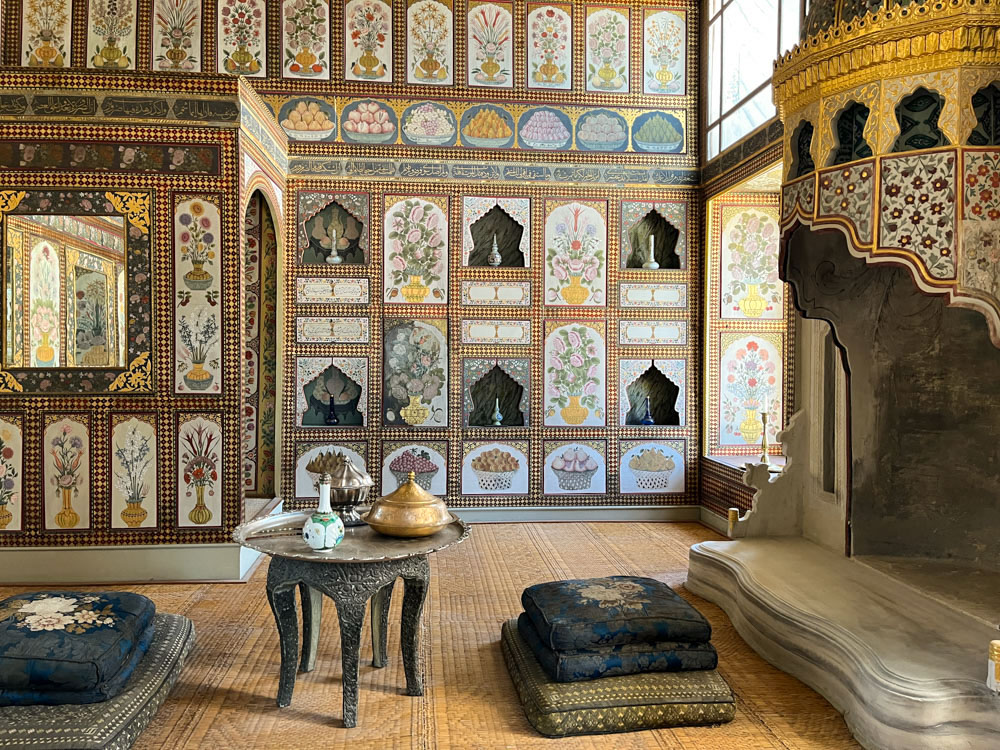
Inside the Topkapı Palace Harem, where walls covered with delicate floral panels evoke the refined private world of the Ottoman court.
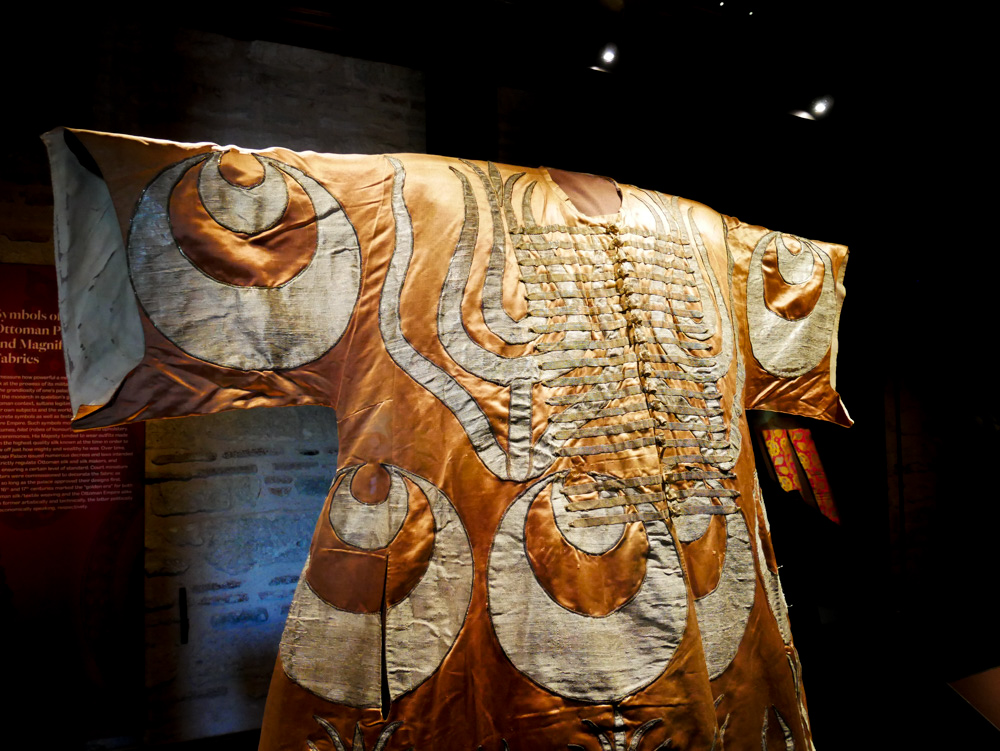
An elaborate Ottoman ceremonial garment, its bold appliqué motifs reflecting the splendour and symbolism of the imperial court.
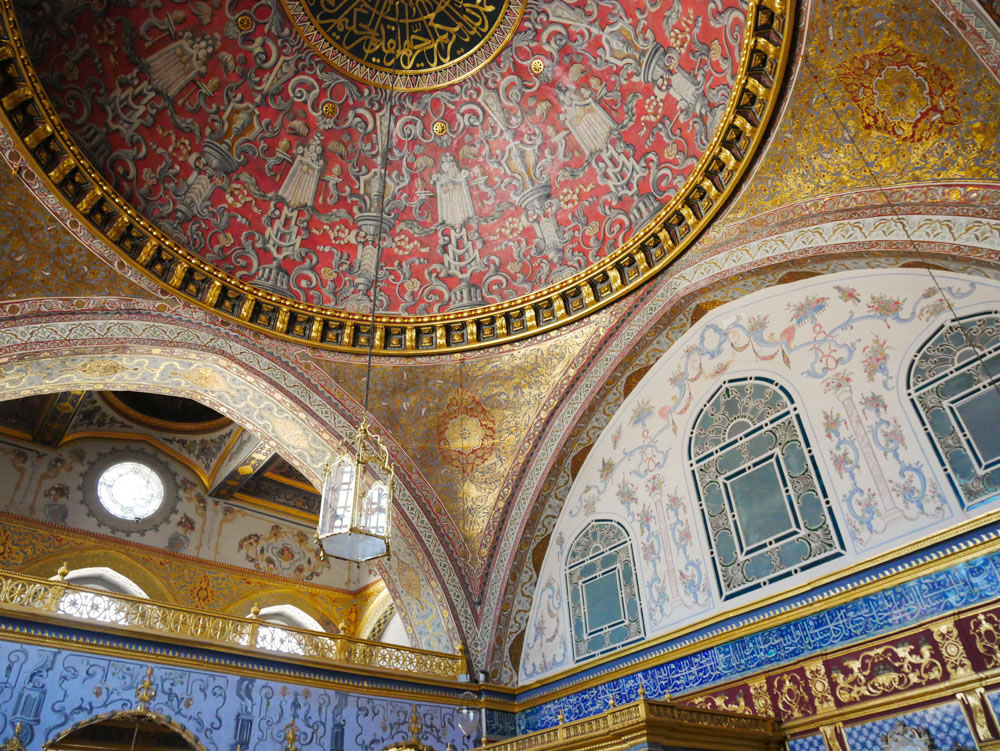
The sumptuous painted dome and gilded arches of Topkapı Palace, displaying the extraordinary decorative richness of the Ottoman court.
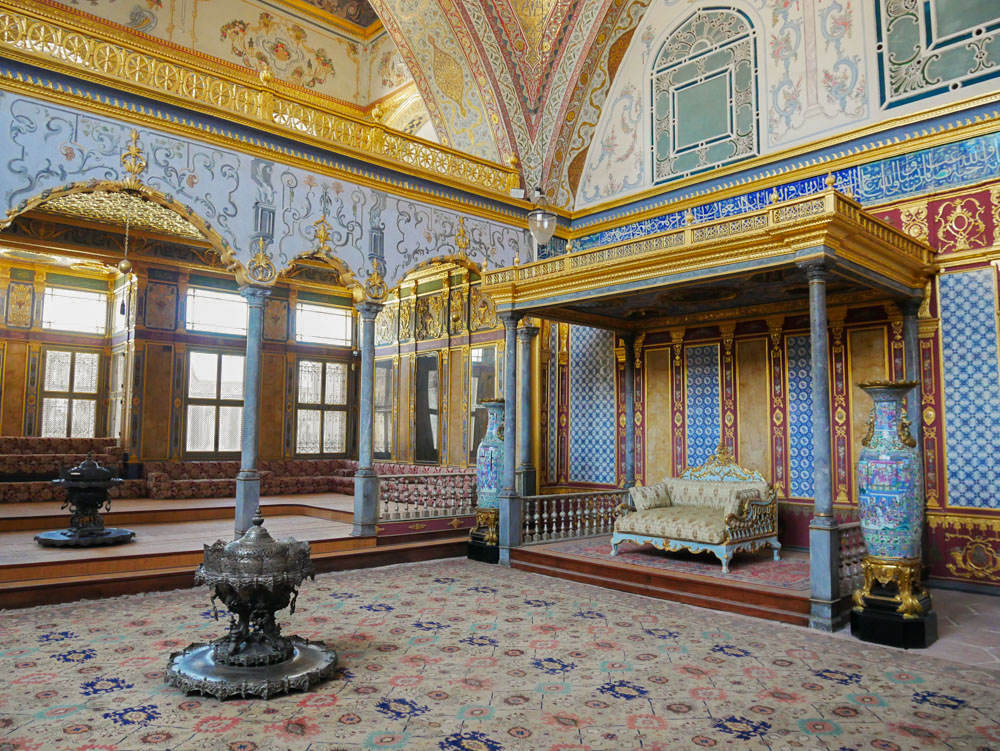
The Sultan’s throne in the Imperial Hall of Topkapı Palace’s Harem, the magnificent ceremonial chamber where the Ottoman ruler received members of the imperial family and presided over festivities and courtly entertainments.
Imperial Istanbul
Discover the best palaces in town and step into a dazzling world of sultans, treasures and Ottoman splendour.