citinotes
The Sapphire Bosphorus
Some cities are explored through their ancient ruins; others through their ports or markets. Istanbul, like Venice, demands a different starting point. To begin to understand Constantinople, capital of the thousand-year Byzantine Empire and later the heart of the Ottoman world, one must approach it from the water. For the true heart of Istanbul is the Bosphorus, the legendary strait that has shaped the city’s history, landscape and imagination.
The Bosphorus unfolds like a film, frame by frame, each bend revealing a different scene. Sailing from the north, the landscape first opens onto wooded hills thick with cypresses and quiet coves, their timeless presence lending the scene an air of serenity. Then come the yalis, Istanbul’s elegant waterside residences, their wooden façades gracefully weathered by salt-laden winds. Imposing cargo ships cast their immense shadows across the water, gliding slowly through the strait as though reluctant to disturb the stillness of the landscape.
Passing beneath the two gigantic iron bridges, the serene waters soon begin to ripple as the journey continues towards the busier southern reaches of the strait. Ferries, private motorboats and excursion vessels draw foaming trails in every direction across an increasingly restless surface. Fishing villages on both shores gradually give way to pearly-white marble palaces, their seemingly endless rows of windows bearing witness to the Ottoman Empire’s final Baroque splendour before its disappearance.
As the landscape grows increasingly urban, modern residences and hotels cast ever-higher shadows along the shores, while the first minarets begin to trace their silhouettes against the distant sky. The proud Galata Tower rises like a lighthouse in the heart of the city, heralding the approach of the legendary Golden Horn.
It was precisely this theatrical quality that fascinated generations of travellers and writers, making the Bosphorus one of the great landscapes through which Europe imagined Istanbul.
Pierre Loti, perhaps the French writer most enamoured of the city, offers a beautiful description of the Bosphorus as it slowly unfolded before his eyes while sailing back to Constantinople in 1887. The pen name of naval officer Julien Viaud, Pierre Loti (1850–1923), was one of the most celebrated writers and travellers of his generation. His naval career carried him across the world, inspiring novels and travel writings in which distant landscapes, cultures and encounters were filtered through an intensely personal sensibility. Istanbul held a unique place in his imagination: he first encountered Ottoman Constantinople as a young officer and returned repeatedly, coming to regard the Ottoman world almost as a second homeland. The city became inseparable from his writing, a place of love, memory and melancholy to which he remained deeply attached throughout his life.
For centuries, the Bosphorus has been both Istanbul’s great maritime highway and one of the keys to its power and prosperity. Linking the Black Sea to the Mediterranean, it carried merchant ships, naval fleets, travellers and goods between Europe and Asia, while controlling access to Constantinople itself.
Yet for the 19th-century Stambouliote — the resident of Istanbul — the Bosphorus was far more than a strategic and commercial artery: it was also the city’s most coveted place to live. Along its shores, the crowded streets and summer heat of the capital gave way to water, wooded hills, gardens and cooling breezes. From the Ottoman elite to the prosperous bourgeoisie, those who could afford it sought waterside residences and yalis, where domestic life opened directly onto the strait. As Xavier Marmier observed in the travel notes below, owning a house on the Bosphorus was not merely a mark of status, but an aspiration deeply rooted in Istanbul’s way of life.
Xavier Marmier (1808–1892) was a French writer and translator elected to the Académie française in 1870. He became especially known for his travel writing, combining personal impressions, observations of local customs and landscapes, and a strong literary sensibility. An indefatigable traveller, he journeyed from Scandinavia and Russia to the Middle East and the Americas, bringing distant places to a wide French readership. Constantinople was a major stage of his journey from the Rhine to Egypt, recounted in Du Rhin au Nil, written following his travels through the Danubian lands and the Ottoman East. His descriptions of the Bosphorus reveal the romantic traveller at his best, fascinated by its waterside houses, changing light and the extraordinary spectacle of life along its shores.
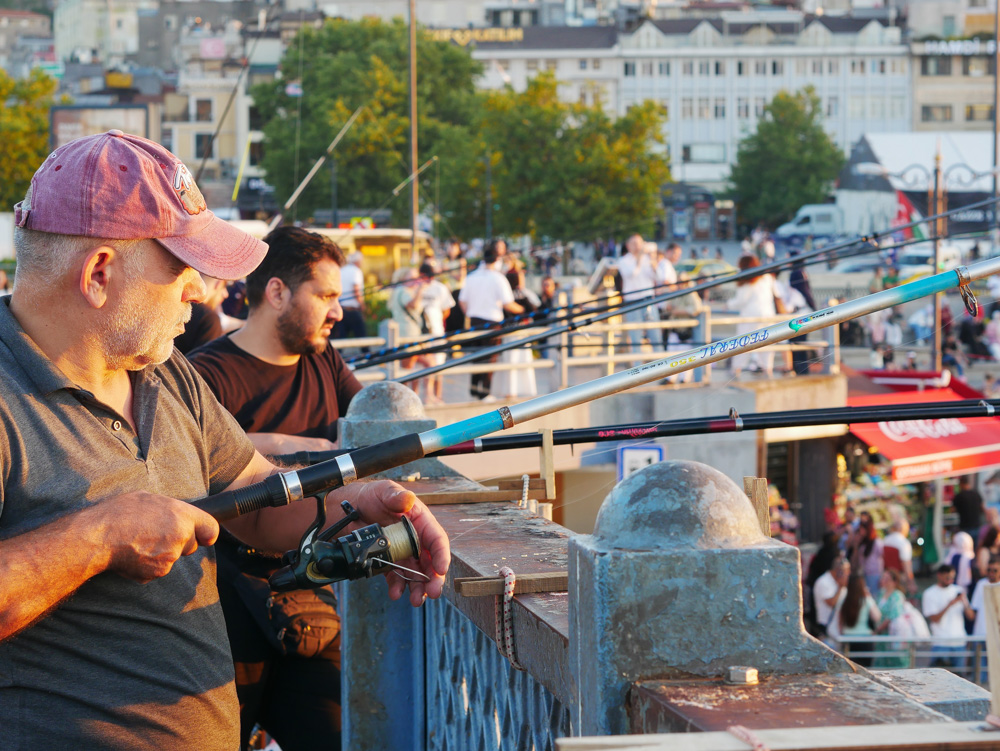
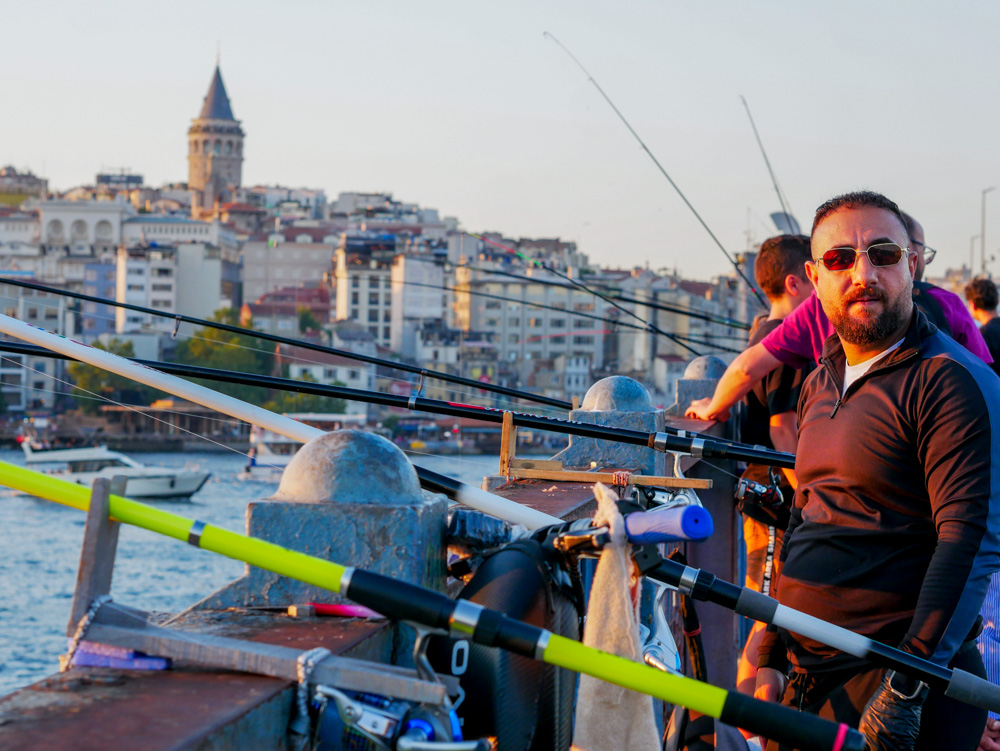
As the Bosphorus narrows towards the Golden Horn, Galata Bridge slowly comes into view, giving the impression of approaching the very heart of Istanbul, if not of the world. Thousands of passers-by stream across its walkways, mingling with the fishermen who, as they have for generations, line its railings with their rods. Below, ferries, fishing boats and excursion vessels criss-cross the restless waters, while the cries of gulls mingle with the muezzin’s call to prayer. The breeze carries the scent of sea salt, ferry smoke and grilled fish. Here, amid the constant flow of boats, people, sounds and smells, Istanbul seems to converge upon a single point: its beating heart.
In the travel notes below, French writer Claude Farrère vividly depicts Galata Bridge as a microcosm of cosmopolitan Constantinople, where peoples, religions, costumes and languages mingle in an extraordinary human spectacle. His exuberant catalogue of faces, sounds and street vendors captures the bridge not simply as a crossing, but as a stage upon which the city’s remarkable diversity seems to parade.
In the fourth chapter, Farrère turns again to the Bosphorus, this time lamenting the intrusion of an increasingly ostentatious European modernity. His complaint reflects a very real transformation: foreign communities had long been established in Constantinople, but their presence and influence became far more visible during the 19th century, as Ottoman reforms, expanding international trade and diplomacy drew the capital ever closer to Europe. Pera and Galata emerged as the principal centres of this new cosmopolitan world, with embassies, banks, hotels, theatres, arcades and European-style apartment buildings reshaping both the architecture and the rhythms of urban life.
Along the Bosphorus, meanwhile, Therapia and Büyükdere developed into fashionable summer enclaves for European diplomats and wealthy Levantine families, with several great powers establishing summer residences there. It is precisely these imposing hotels, embassy palaces and Western-style residences that Farrère so bitterly laments, seeing their scale and architecture as a brutal intrusion upon the older landscape of wooden yalis, villages, mosques, cemeteries and wooded hills. His wonderfully exaggerated threat to burn them down reveals less a rejection of Europeans themselves than a nostalgic desire to preserve the visual poetry and harmony of the old Bosphorus.
Claude Farrère (1876–1957), the pen name of Frédéric-Charles Bargone, was another French naval officer turned novelist and traveller, elected to the Académie française in 1935. He became particularly renowned for exotic novels inspired by his naval travels, blending adventure and romance with vivid portrayals of distant societies; Les Civilisés won the Prix Goncourt in 1905. Farrère drew much of his literary inspiration from the places he encountered at sea, particularly Asia and the Ottoman world. In 1903, he served in Constantinople aboard the Vautour, under the command of Pierre Loti himself, and developed a lasting fascination with Turkey and its Ottoman capital. The city inspired several of his works, notably L’Homme qui assassina, which draws on his memories of Constantinople to evoke its cosmopolitan society, diplomatic circles and landscapes during the twilight years of the Ottoman Empire.
Among the many features that have captured travellers’ imaginations along the Bosphorus, few are as inseparable from its landscape as the yalis. Built directly at the water’s edge, these elegant waterside residences flourished particularly during the 18th and 19th centuries, when Ottoman pashas, dignitaries and wealthy families sought the cooler, greener shores of the strait, away from the crowded heart of the capital.
Mostly constructed of wood, with long façades, projecting windows, terraces and private landings, the yalis created an intimate dialogue between domestic life and the water. Their succession along the wooded shores gave the Bosphorus one of its most distinctive features: a landscape in which architecture seems not to dominate nature, but to grow gently out of it.
It is precisely this almost organic quality that Abdülhak Şinasi Hisar captures in his memories, transforming the old yalis from mere houses into living beings, each endowed with its own character, memories, wounds and soul.
Abdülhak Şinasi Hisar (1887–1963) was a Turkish novelist, essayist and memoirist, and one of the most distinctive prose writers of the early Republican era. He is especially remembered for his nostalgic, highly poetic works, in which memory, vanished ways of life and the atmosphere of old Istanbul often matter more than conventional narrative. The Bosphorus lay at the heart of his writing: its yalis, gardens and moonlit waters, and the refined social world along its shores that was already disappearing. Through these works, Hisar became one of the great chroniclers of what he conceived as a distinctive “Bosphorus civilization,” preserving through memory and literature the Istanbul of his youth.
Further on, in the sixth and final chapter of this rich tribute to the Bosphorus, Istanbul’s shimmering blue pearl, Hisar captures the slow rhythm of life along its shores, where time seems to follow the movements of water and light rather than the clock. From the golden reflections of morning to the blue stillness of ikindi, the traditional late-afternoon hour following the afternoon prayer, and on to the melancholy of dusk and the silence of night, each moment acquires its own colour and mood. Life in the yali unfolds accordingly, through swimming, meals, excursions and contemplation. The Bosphorus becomes not merely a landscape to admire, but a rhythm of life to which body and soul gradually surrender.
Citinotes
chapter 1
First Glimpse from the Deck
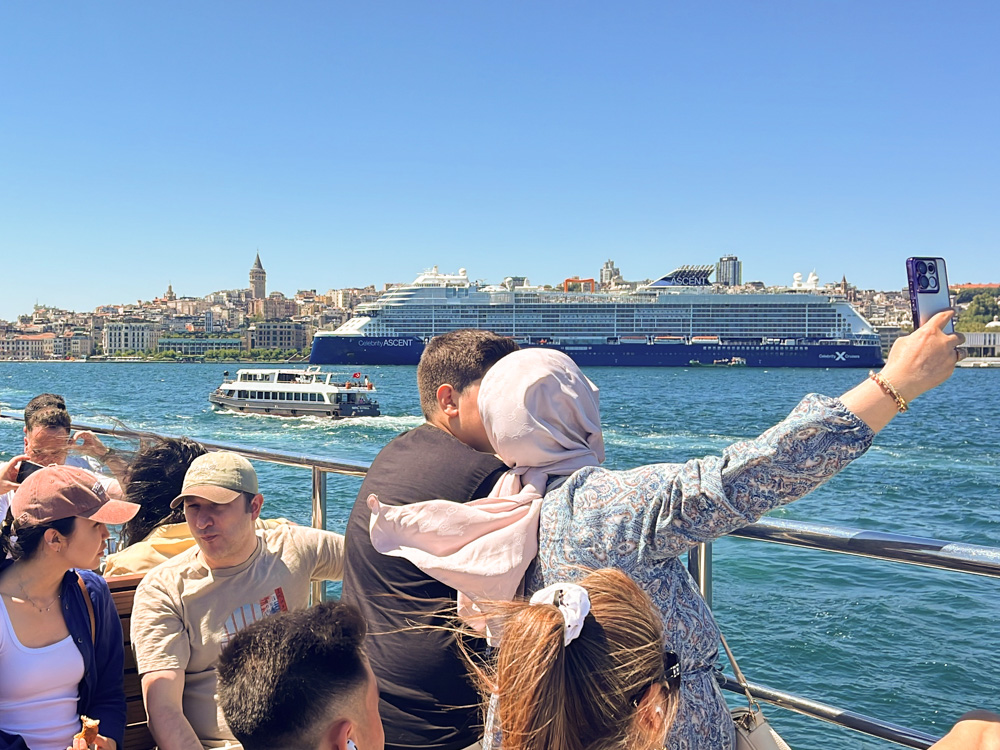
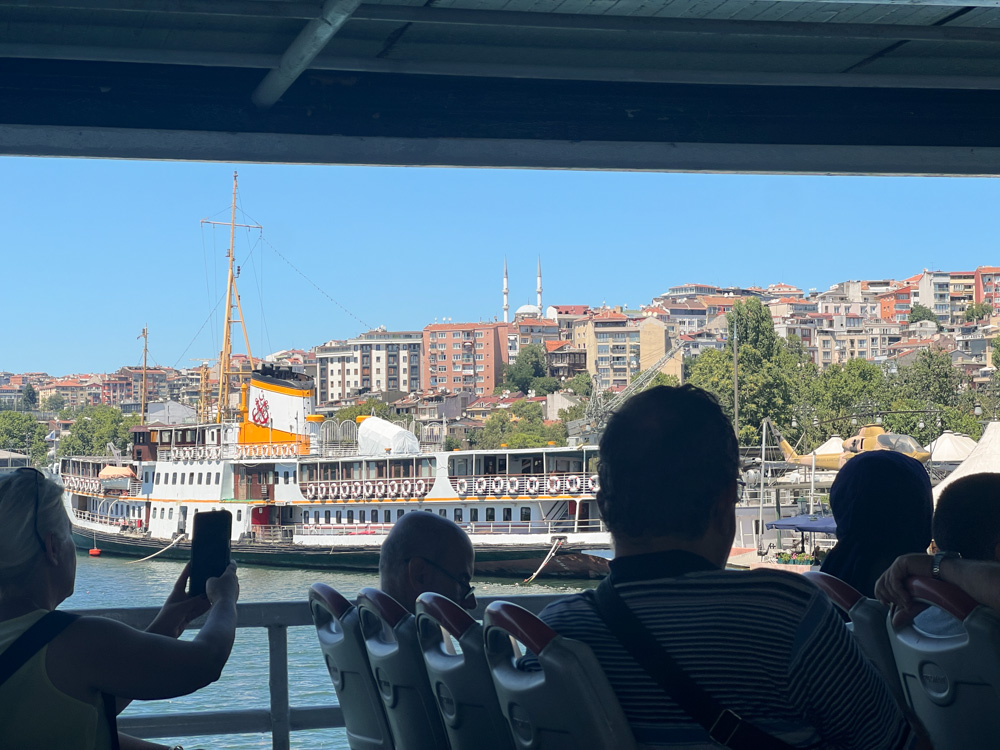
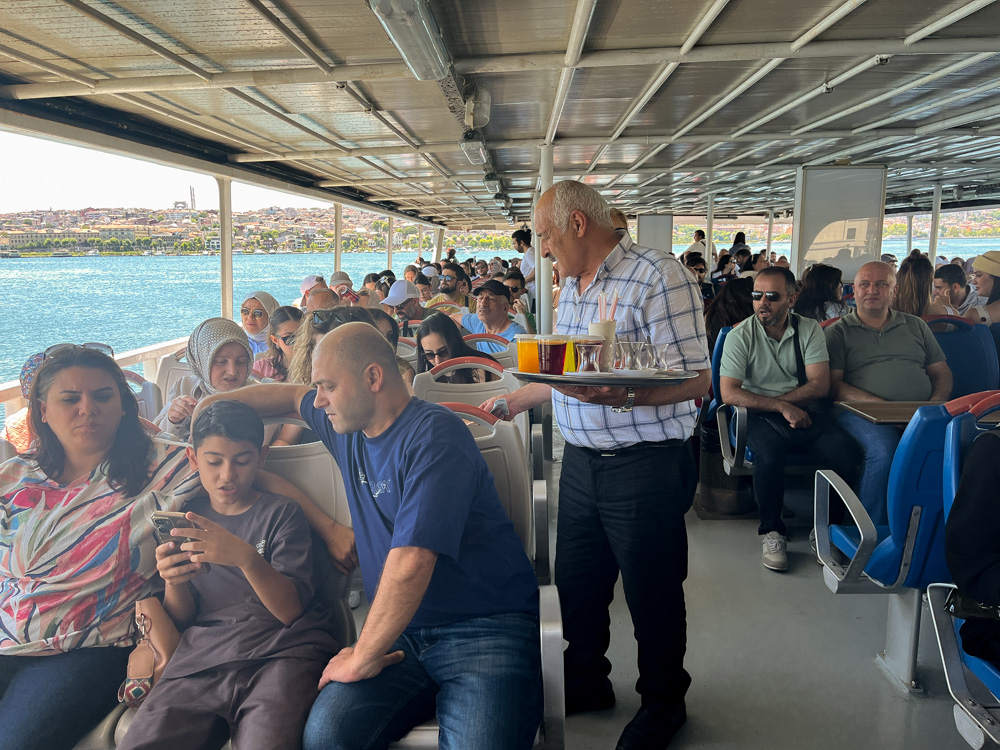
At daybreak, an employee with a foreign accent came to inform the passengers in their cabins that we were nearing the entrance to the Bosphorus. I had barely fallen asleep, having spent the night lost in thought, and awoke with a start, my heart pounding, at the mere mention of the Bosphorus.
On the cold deck, the passengers appeared one by one, indifferent and merely disappointed by what they were being shown. Indeed, the entrance to the Bosphorus looked rather gloomy, between those unremarkable mountains, still vaguely outlined in dark hues. It was an autumn sunrise, grey and misty, beneath a low, heavy sky. They could hardly see anything through the banks of fog trailing like veils.
A real shame for these tourists: the effect of the arrival would be lost. […] I had not noticed last night the third-class passengers crowding the deck: they are indeed real Turks, these men in caftans, these veiled women. And then suddenly, as we approach the shore, a penetrating, distinctive, exquisite scent reaches us, a scent once so familiar and long since forgotten: the scent of Turkish soil, something that comes from the plants or the people, I do not know, but which has not changed and which, in an instant, brings back a whole world of impressions from the past. Then, abruptly, a ten-year gap opens in my life, a collapse. […]
We begin to descend the Bosphorus, and the grand spectacle slowly unfolds along both banks, as though I had left only yesterday. […] The atmosphere is so calm now that it astonishes me, and I scarcely recognize these cemeteries where, right at the water’s edge, lie the tombs of Turkish women. I feel a slight anxiety only as we pass beneath the tall, giant cypresses, with their pink trunks and black foliage. […] Already, here are the imperial kiosks and the great harems; then comes the succession of white palaces with their marble quays.
And finally, over there, high above, suddenly emerging through a break in the mist, appears the incomparable silhouette of Istanbul. Oh! Istanbul is there! Quite real, brought very close now, beneath a clear and commonplace light, reduced to its most ordinary appearance, which ten years of dreaming had somewhat transformed, yet almost as beautiful as in my memory. […]
The anchorage is noisy, amid the jumble of steamers and sailing ships flying all the flags of Europe. And immediately begins the furious invasion of boatmen, customs officers and porters; a hundred caiques storm the ship, and all these people, boarding like a tide, speak and shout in all the languages of the Levant.
Oh! I know all this so well: this hubbub of arrivals, these voices, these intonations, these faces; this mass of ships around us and these black plumes of smoke, above which, there in the clear sky, rise the domes of the holy mosques! I too mingle with all this noise; and Turkish words, even the most forgotten, come flooding back to me at once.
With the boatmen over my passage, with the porters over my trunks, I discuss matters that are utterly indifferent to me, simply out of a need to move, to talk. Even in the boat, where I am finally settled with my suitcases, I continue some astonishing haggling, and thus, almost without emotion, except perhaps for a tremor as my foot touches the ground, I find myself ashore, on the quays of Constantinople.
After more than an hour wasted on customs formalities, passports and I know not what else, on these quays in the lower part of Galata, still filled with the same strange swarming and the same clamour, here I am at last, up in Pera, settled into a respectable hotel crowded with tourists. Nearly ten o’clock already; what a waste of time, when every minute ought to be precious.
Pierre Loti, Fantôme d’Orient, Paris, Calmann-Lévy, 1892
chapter 2
Where Every House Seeks the Water
It is at Büyükdere that the beautiful scenes of the Bosphorus begin; from there they unfold like an immense panorama, with such a variety of hues, landscapes and effects of light that no painter could capture their harmonious whole, and no writer could convey their infinite charm. […]
The shores of the strait are crowded with them. Not a single spot remains vacant upon this alluring ground. Everyone wishes to have a dwelling there, a summer villa or a family home, small or large, no matter, provided it stands near the Bosphorus; provided one may enjoy that cloudless sky, the fragrance of flowers and the cool freshness of the waters. […]
Do not look, among this multitude of houses, for the symmetrical regularity to which so much importance is attached in Europe; it is enough that they should be arranged, as best they may, along the strait, following its curves and windings.
There are some, and many of them, that even rebel against such submission and, borne upon slender piles, advance proudly out over the Bosphorus without regard for their neighbors. Whoever managed to build themselves a dwelling there consulted only their own taste, obeyed only their whim. This one wanted a chalet in the Jura, that one a Neapolitan villa, a Chinese kiosk. In shape, height, and size, all are painted in various colors. One would think one was seeing, says Byron, a freshly painted screen or an opera set. Near the salons of an ambassador is the humble dwelling of a boatman; near the barred windows of a pasha; near the mysterious palace of the Grand Seigneur is the room of a laborer, cheerfully open to the sea breezes and the light of day.
Seeing these immense rows of houses, these imperial harems and commoners’ homes, so many public squares with their shops and cafes, so many mosques with their minarets, so many buildings of every kind, gleaming like the iridescent wings of a flock of butterflies in the sunlight, one wonders if this isn’t the magnificent Byzantium, the voluptuous Rome of the Late Empire, the proud city of the sultanas.
No, it’s merely a necklace of pearls and emeralds that it has cast along the Bosphorus, like one of those beautiful Eastern maidens who, on their holidays, let their braids of hair, strewn with flowers and gold sequins, flow behind them. […]
Soon we see three distinct cities taking shape against the azure sea: Pera, the Frankish city; Scutari, the Asian city; and Constantinople, their queen. Little by little, we discern the undulations of the land they occupy, the slope, the wave that separates them, the cypress forests that, in the city of the living, veil the city of the dead.
Then we find ourselves in the harbor, between the Galata Tower and the dome of Hagia Sophia, facing this unparalleled port, best described by its name, the Golden Horn: to the left, the Sea of Marmara breaking at the foot of the Seven Towers; to the right, the Bosphorus we have just sailed through; behind us, the vast districts of Shkodër, and on either side, barracks, mosques, clusters of houses and palaces huddled together, terraced on the hills, heaped on the plain.
A countless crowd bustles the quays. Ships from every country are moored around us; still others are arriving from southern and northern regions: others have raised their anchor and sail under full sail; Thousands of caïques glide, almost fly, over the surface of the water with such lightness that they scarcely leave behind them even the faintest fleeting wake.
Xavier Marmier, Du Rhin au Nil, Paris, Arthus Bertrand, 1846
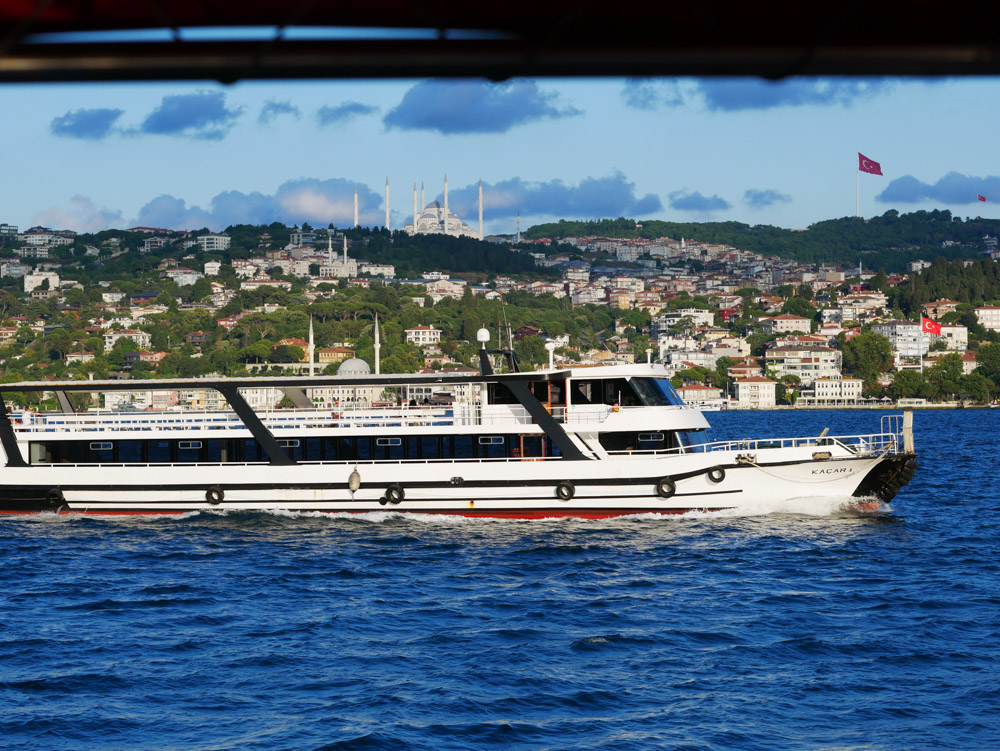
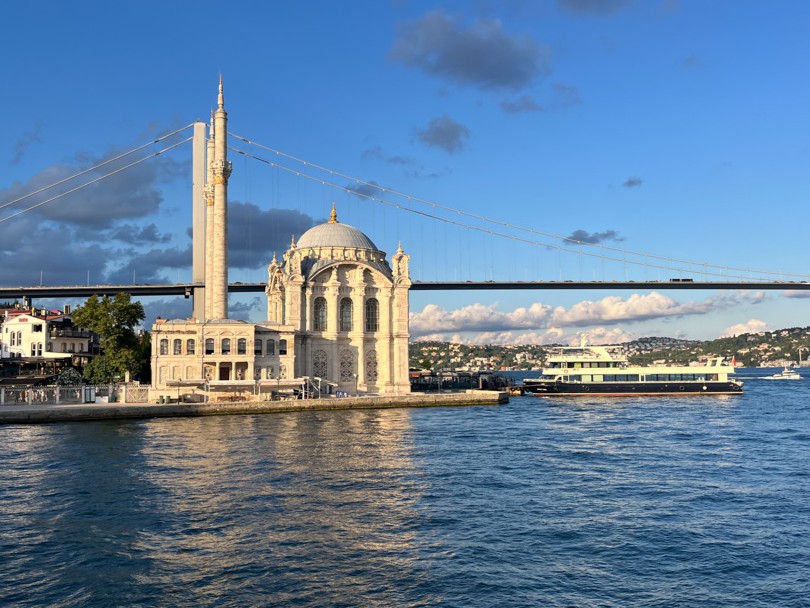
The elegant Ortaköy Mosque rises directly beside the Bosphorus, framed by the sweeping span of the Bosphorus Bridge.
chapter 3
All the World on One Bridge
I, on the other hand, have returned to my walk, deliberately lingering amid the teeming crowds crossing the water. I never tire of admiring this bridge over the Golden Horn. It is surely the most magnificent bridge in the whole world.
What a motley throng of peoples, what exotic races, what unexpected religions jostle one another incessantly, hurrying from Istanbul to Pera and from Pera to Istanbul! Fezzes, turbans, tarbooshes, bonnets, hats, feathered toques and tcharchafs: all are signs of origin worn upon the heads of these men and women who have come from the most unexpected corners of the world.
Within the space of a single crossing, I pass mounted soldiers and foot soldiers, porters bent beneath their loads, eunuchs in sharply tailored frock coats, a bewildered band of pilgrims from Bukhara, their Mongolian eyes wide with wonder; a harem carriage closed like a coffin; four Persians in astrakhan hats; two fire engines galloping past; twelve Turkish ladies wearing their veils for amusement; six policemen, five imams, three dervishes, a Bulgarian bishop, two Little Sisters of the Poor, and some two hundred other people whose origins defy classification.
And I have not even mentioned the hubbub of the improbable vendors crowded along every pavement, crying their improbable wares at the top of their lungs: rose-flavoured Turkish delight, aniseed simites, Angora honey, harem lozenges, chequered handkerchiefs, English pins, Damascus apricots, postcards, obscene photographs and genuine cherry water. All this for a penny, for next to nothing: « On paras, bech paras, bech paraya!»
Claude Farrère, L’Homme qui assassina, Paris, Librairie Paul Ollendorff, 1907
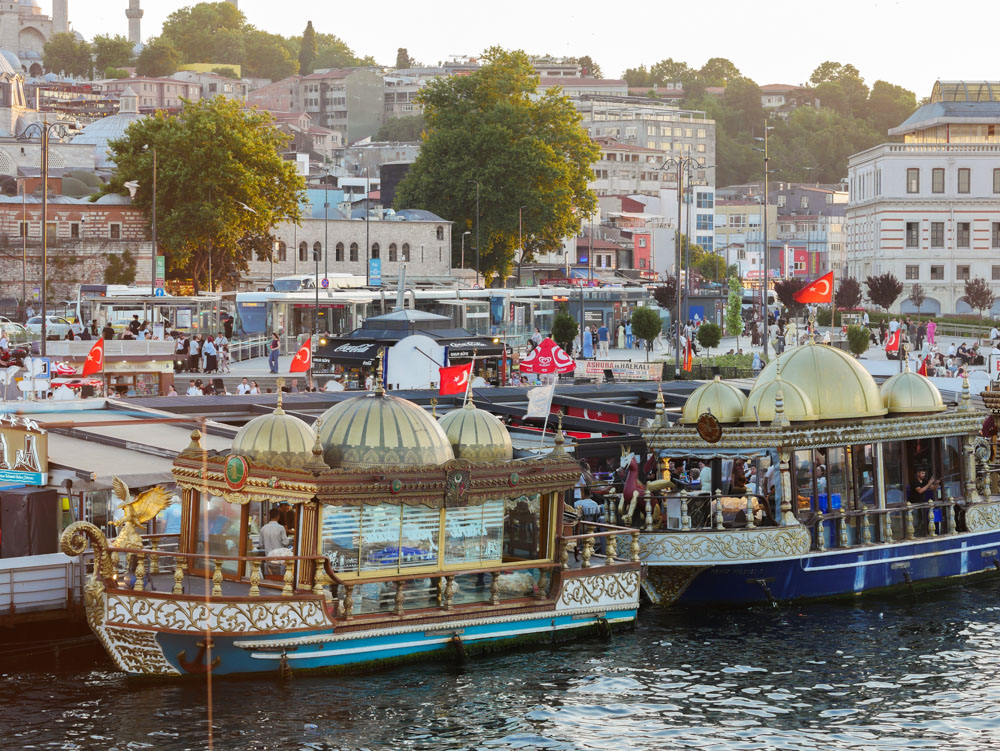
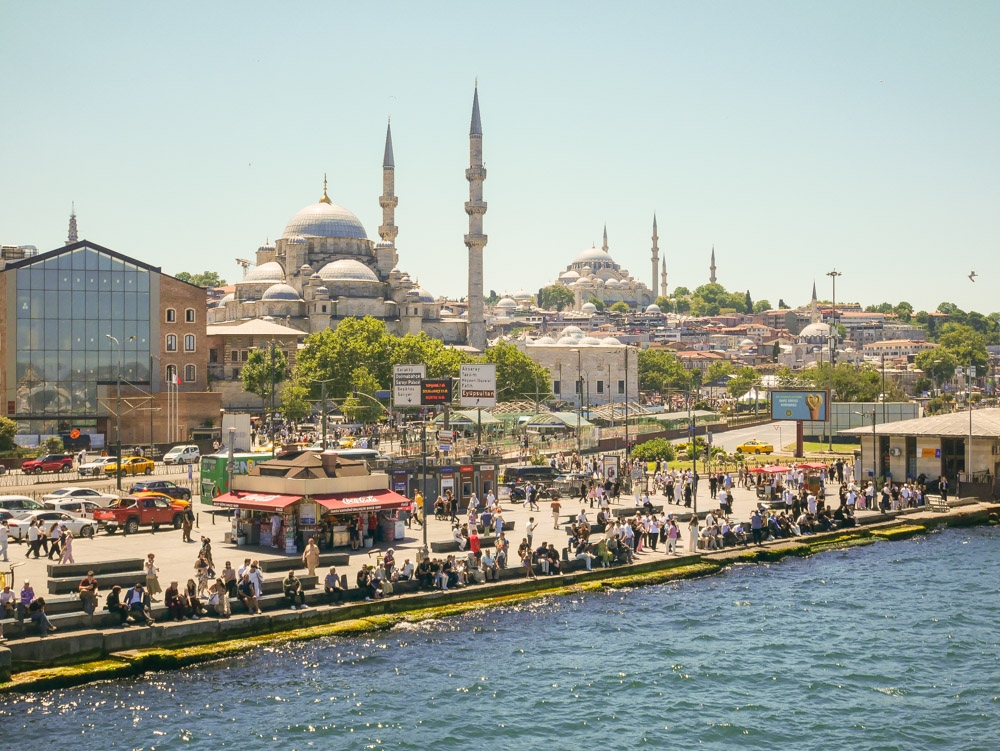
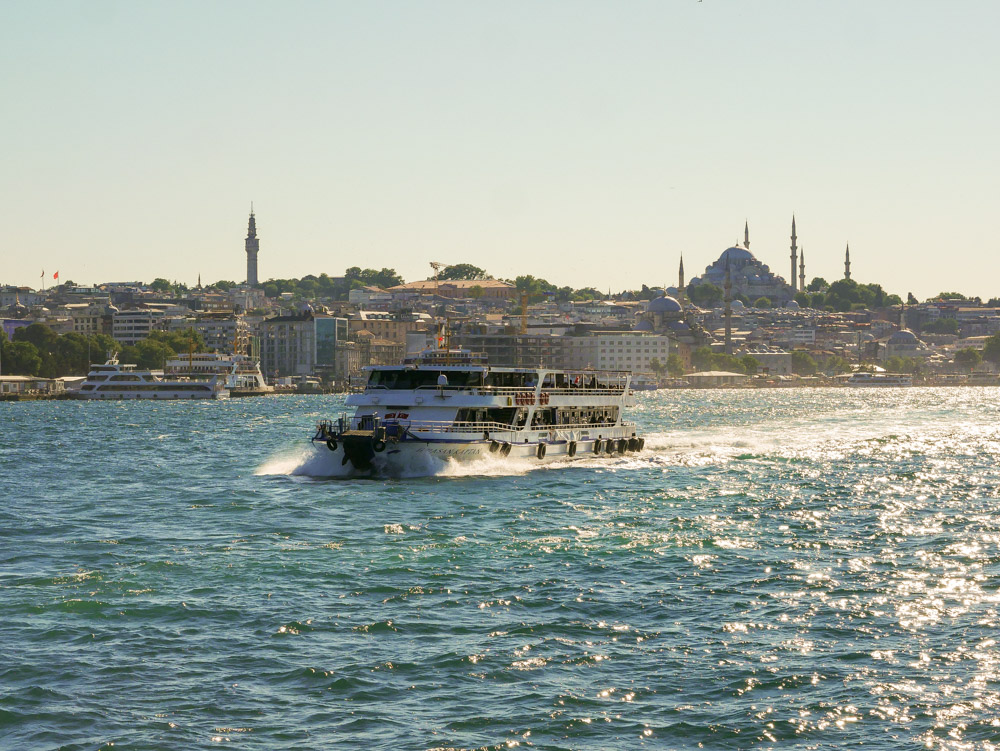
A sweeping view from Galata Bridge across the bustling Eminönü waterfront, with the New Mosque in the foreground and the Süleymaniye Mosque crowning Istanbul’s historic skyline beyond.
chapter 4
And Then Came the Europeans…
The Bosphorus, is it? We know what it is: a lapis-lazuli sea, a marble palace, a sapphire sky, and sultanas like pearls leaning over the abyss into which, sooner or later, they will be cast. — Yes. Well, it is nothing like that. Nothing at all.
The water is not lapis lazuli, nor is the sky sapphire. Grey and blond prevail everywhere, with a kind of mauve haze floating over every line and softening every hue. There are marble palaces, but very few: eight or ten, scattered along two banks, each a good twenty kilometres long. The Bosphorus is much longer than one imagines. It is a very beautiful river, winding between lovely wooded hills that hug it closely and hem it in. At the foot of these hills, countless villages line the banks in continuous rows of little Turkish houses, half on land, half over the water, for many of their terraces, built of rough-hewn planks, rest upon stilts.
Here and there, a stretch of quay paved with old, chipped flagstones; a great villa, a yali of pink stone or ancient purplish wood; a white mosque with a beautiful dome, its minaret like a candle; and sometimes a Turkish cemetery descending in terraces towards the water—a cemetery planted with tall cypresses and translucent willows, scattered with little blue or green Muslim stelae and adorned with golden epitaphs. The charm of it all is gentle and captivating: a charm of harmony, perfect balance and peace. The rolling hills, the broad, low houses, the trees with their restrained European greenery, the diaphanous mist cast over the landscape like the bloom upon a plum, and the sun that gilds without dazzling—all combine to create a delightful and temperate whole, one that does not impose itself violently, but insinuates itself, penetrates deeply, and takes possession of you.
The misfortune is that the Europeans have interfered and, just as Istanbul has its Pera, so too does the Bosphorus: some thirty dreadful people have built along its banks. Facades taller than the hillsides they conceal, resembling in turn school buildings or elaborate pastry displays: hotels and palaces—no, palaces!
How I would love to bivouac in those barracks one evening after a battle, with my hussars! We would put everything back in order so neatly the following morning, with nothing more than a few bundles of sticks and a little kerosene.
Half past seven Turkish time, a quarter past two Frankish time. To the left, the large village of Yeniköy; to the right, the little town of Beykoz. Behind us, on a promontory of the Asian shore, Kanlıca, the most exquisite of the Bosphorus hamlets; ahead, on the European shore, Therapia and Büyükdere, the “select” spots chosen by the six embassies for their summer quarters. It is not bad; there are magnificent trees. The şirket approaches an admirable yali, red as dried blood, nestled against a terraced park planted with lindens, beeches, chestnuts and cedars—the most beautiful I have ever dreamed of: the French Palace. That is where I am going first.
We disembark. The quay is crowded with carriages. The gate. Footmen and servants. (The servants are sworn retainers, entitled to carry arms—and they make liberal use of the privilege.) All these liveried figures rush forward:
“Monsieur le Marquis…”
Damn! No more laughing.
Claude Farrère, L’Homme qui assassina, Paris, Librairie Paul Ollendorff, 1907
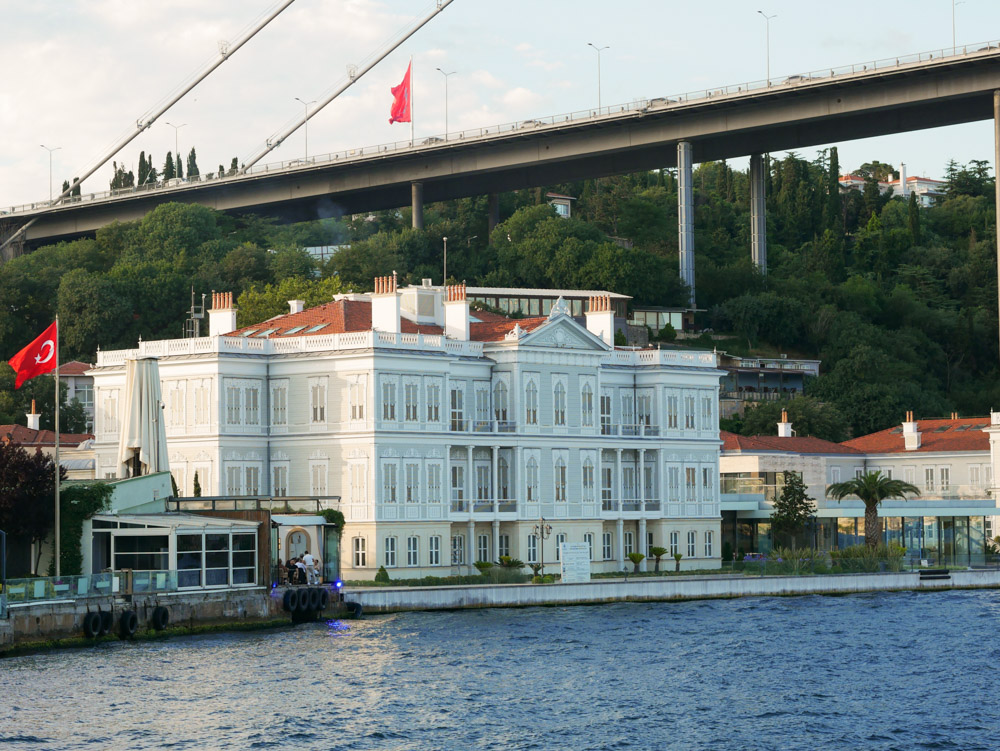
An elegant white waterfront mansion beneath the Bosphorus Bridge, where Ottoman-inspired architecture meets modern Istanbul.
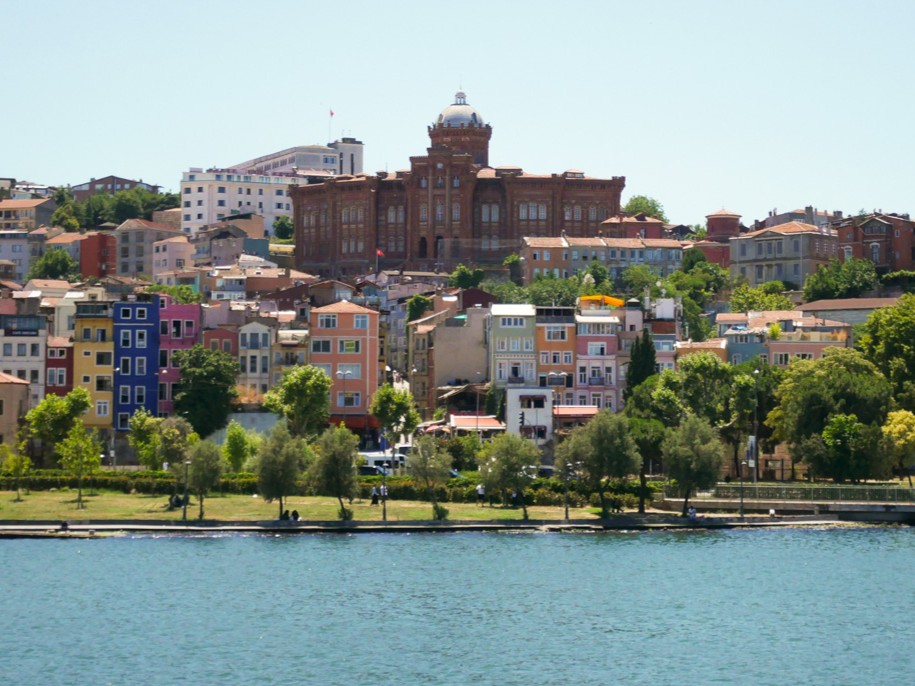
The colourful waterfront of Fener, crowned by the imposing red-brick Phanar Greek Orthodox College overlooking the Golden Horn.
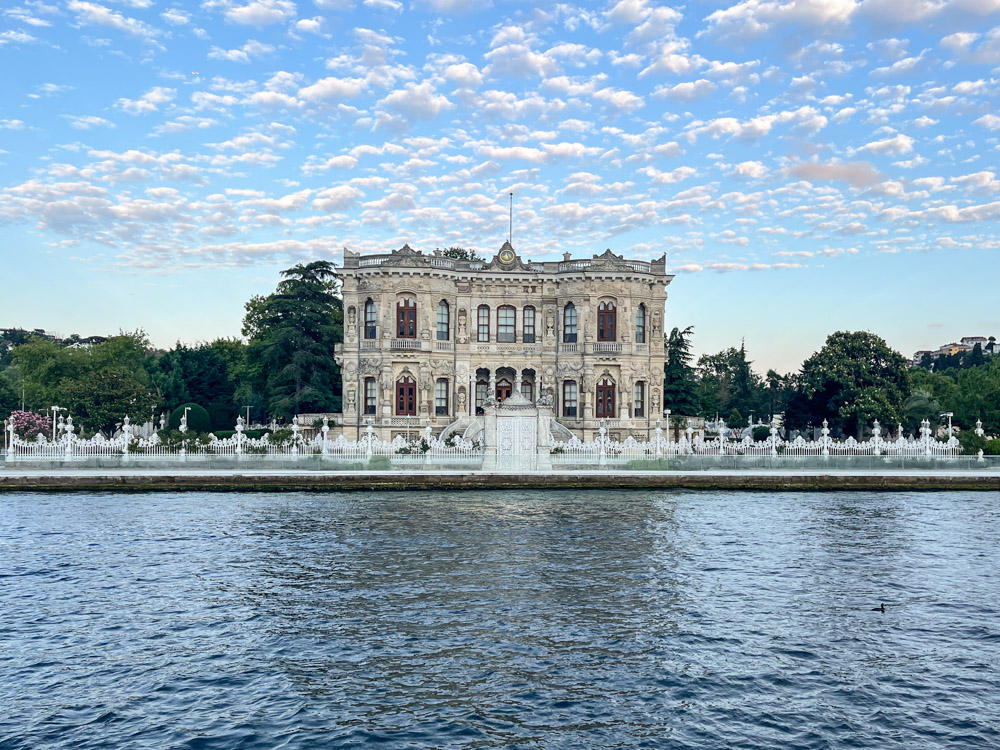
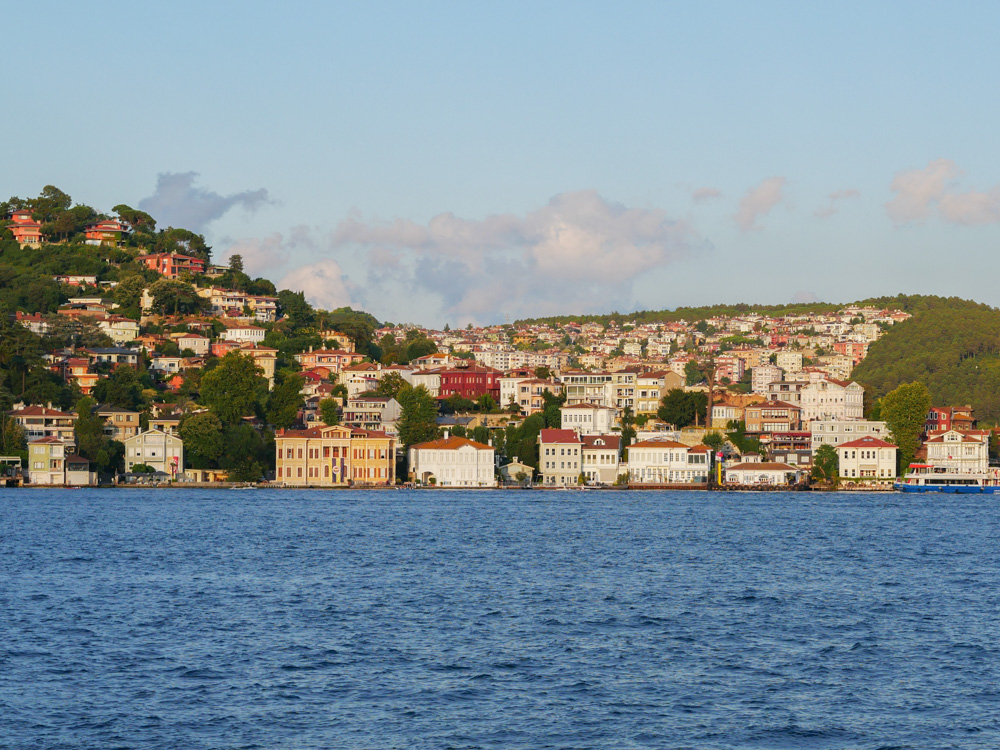
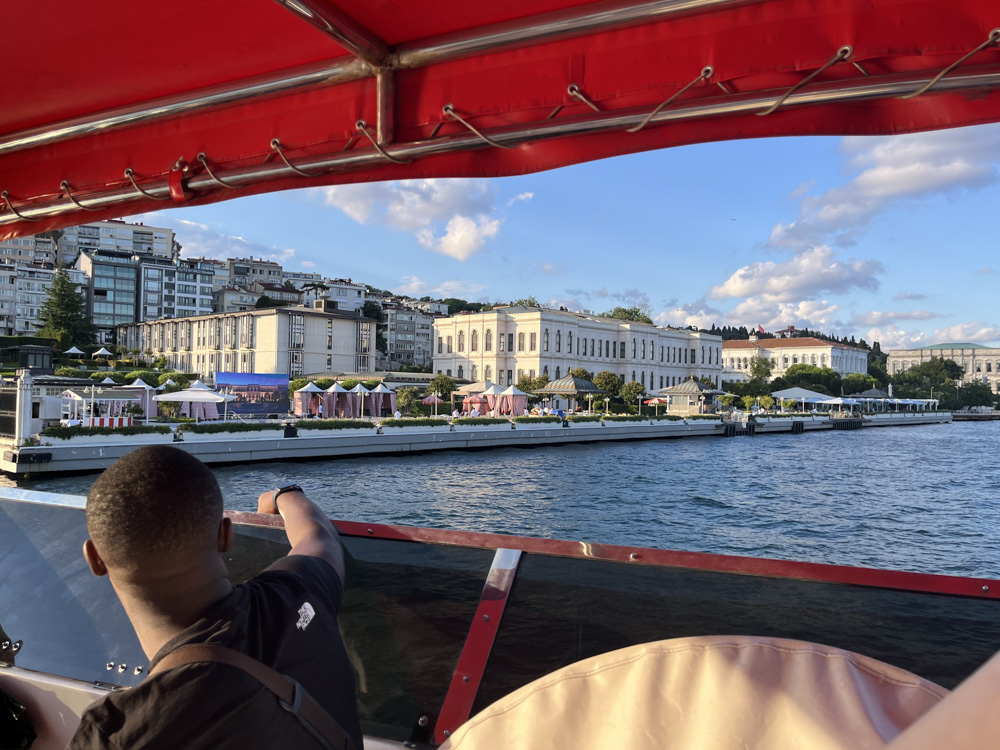
An elegant Ottoman waterfront palace reflected in the Bosphorus, one of the many architectural jewels lining Istanbul’s shores.
Dolmabahçe’s ornate Gate to the Bosphorus frames the brilliant blue waters that made the palace one of Istanbul’s most spectacular imperial residences.
chapter 5
The Yalis, Houses with a Soul
The old yalis of the Bosphorus seemed to have sprung not from an architect’s calculations, but from the inclinations of a heart, the whims of a capricious mood, the ailments of a body, the vagaries of life.
Aged, wrinkled, faded, withered, dilapidated, swollen with damp—or concealing beneath later additions the ruins of their former youth—they told legends and recited poems. Some, freshly painted, groomed and adorned, spoke of youth, maturity and old age. Some were efendis, beys or pashas; others gossips or grand ladies, friends, relatives or strangers.
All seemed like living creatures; all expressed a soul, a personality, a life of their own.
There were very tall ones, resembling giants grown beyond their natural proportions; medium-sized ones, giving the eye a reassuring sense of balance; and small ones, like children surrounded by their toys.
I recognised them all from afar by their outward appearance; of some, I even knew the secrets of their most hidden wounds, the depths of their souls.
The old yali belonging to the eldest member of my family, at the tip of Kanlıca, with its vast vestibules covered in matting, its chandeliers large enough to shelter countless little houses, and its rooms with pools, all teeming with dreams, resembled an enormous ship from bygone days, carrying within it something of the power of a vanished empire and now stranded upon the shore. Its garden ended in a latticed jetty sloping down towards the sea, as though the waters were slowly eroding it, piece by piece.
One of our neighbours had, in a garden shaded by ancient trees and tangled with flowers that seemed oblivious to winter, an orangery with multicoloured panes. It was as though, in this place where their fragrances lingered, the springs of former years had never died but continued to live on, mingling and intertwining to create an intoxicating atmosphere. Like those immense oceans whose farthest shores we dare not seek, I could not, swimming upon waves of perfume, reach their final shore, and so I turned back.
Most of the yalis resembled old women educated in another age, whose minds preserved a local, Oriental knowledge unknown to us, and whose hearts sheltered a world that, to our eyes, had already passed away. Their very existence seemed out of harmony with the present. In their dreams, their habits and their silences, I could easily recognise the people they resembled.
The Bosphorus is one of the purest cradles of poetry in the world, and its yalis, seemingly intoxicated by the enchantment of the waters in which they are reflected, are simple yet perfect snares, capturing the mind in the poetry of a contemplative life.
Abdülhak Şinasi Hisar, “Varlık,” in Anthologie des écrivains turcs d’aujourd’hui, Istanbul, Direction Générale de la Presse, 1935. Translated from Turkish by Edmond Saussey.
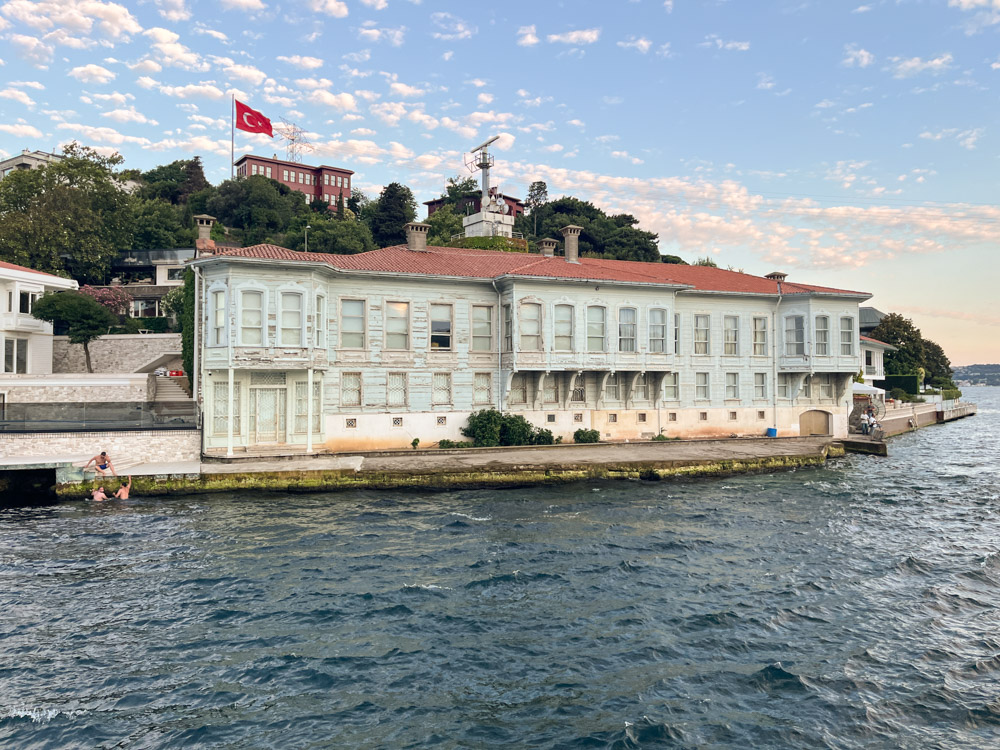
A grand, timeworn wooden yali stretches along the Bosphorus, its faded façade preserving the atmosphere of Istanbul’s old waterside world.
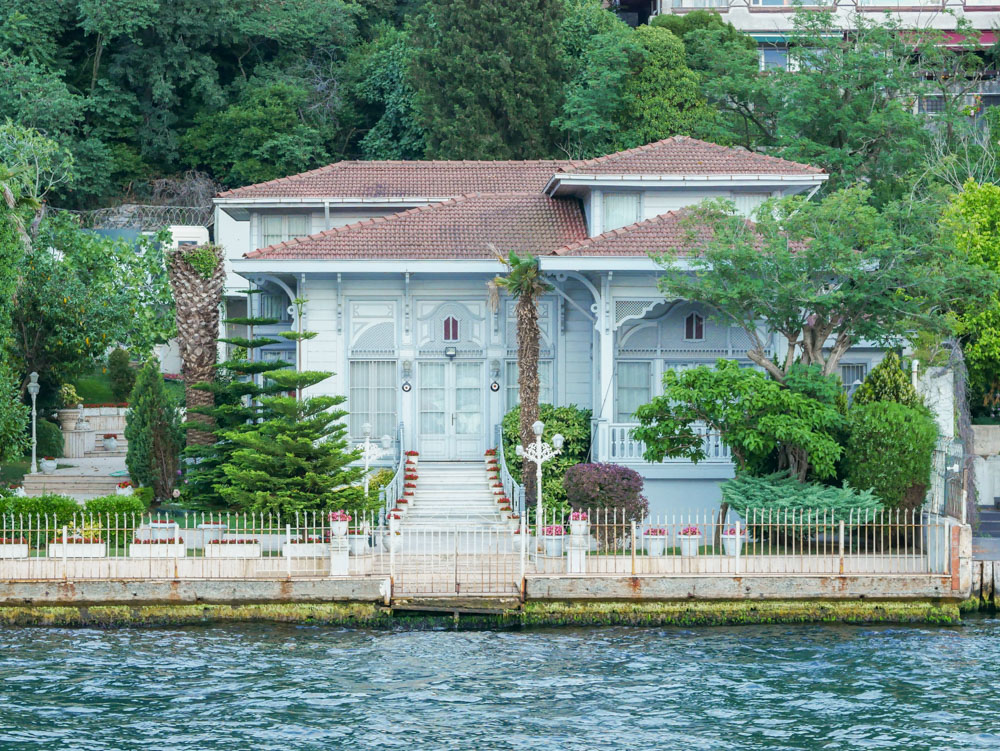
A graceful wooden yali nestled among lush gardens on the Bosphorus, recalling the refined waterside life of old Istanbul.
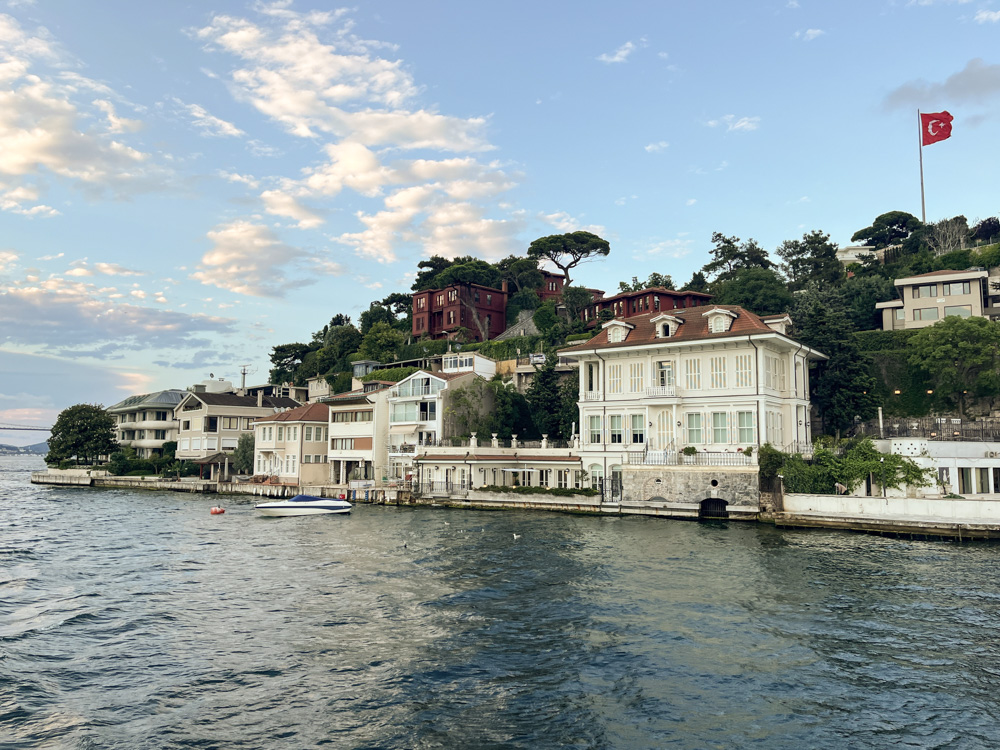
Elegant waterfront yalis line the Bosphorus, their wooden façades rising directly from the water beneath the green hills of Istanbul.
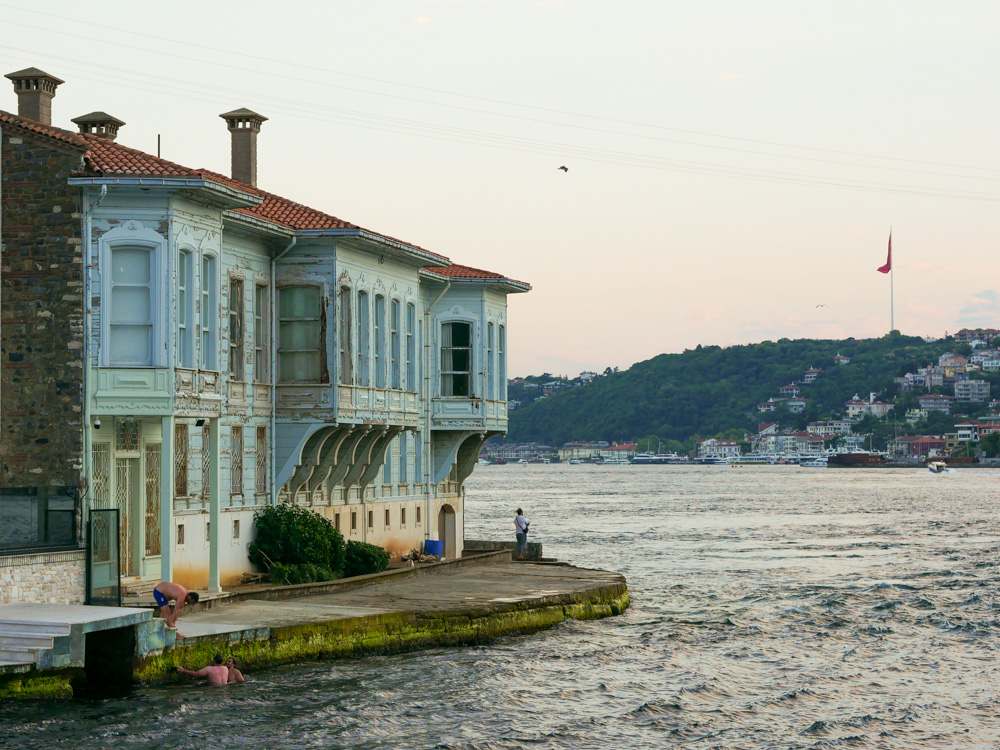
A weathered wooden yali stands directly on the Bosphorus, with the Asian shore and a monumental Turkish flag visible across the water.
chapter 6
The Slow Hours of the Bosphorus
The Bosphorus is one of the purest cradles of poetry in the world, and its yalis, seemingly intoxicated by the charm of the waters in which they are reflected, are simple yet perfect snares, holding the mind captive to the poetry of a contemplative life.
How can one explain what a century, a lifetime, a season, a single day spent in the valleys of the Bosphorus is, without showing it or letting one breathe its air? It is like trying to convey what a rose is without showing it or letting one breathe in its fragrance. How can one describe its colour, which stirs the senses? How can one make another feel its perfume, which makes the heart swoon?
In the morning, the sun, slipping between the still-lowered blinds and curtains, cast upon the ceiling the reflections of the dancing waters, like electrified rods of gold.
Then the maid would come, bringing tea and the morning paper; accompanied by the friendly breeze, she would enter and brighten the room with her presence, then leave again. Through the first open window, a new day dawned, sunny and joyful.
Just as, before plunging into the sea, we hesitate for a moment at the thought of the cold, then throw ourselves headlong into the delicious coolness awaiting us, so we plunged from our beds into the delights of the new day.
Swimming, chasing one another and playing through the halls of the yali and along the garden paths carried us effortlessly, as though upon a raft, towards the peaceful hours of meals. After those hot and heavy middays, whose torpor overcame everyone, the hour of ikindi blossomed like a rose: the blue hour, lovelier and more poetic than any other.
At such moments, I regretted not having devoted myself to poetry, drawing and music. For when we savour the beauty of life and the world, we long to be poets so that we might express it; when we contemplate its beauty, painters so that we might depict it; when we hear its harmony, musicians so that we might echo it. And then we are astonished at the impotence and sterility of the poets, painters and musicians we know.
There is something in the Bosphorus that seems to demand poetry, painting and music in order to be expressed; something that can never quite be grasped, and which leaves the soul with an eternal longing.
The idle, slow and carefree day, which had peacefully melted the gold of its light into the blue of ikindi, suddenly grew hurried; it faded and darkened, slipping into the mauve hours, the meditations of evening, its nostalgias and farewells.
Around the hour of ikindi, the sun disappeared behind the yali. Then the murmur of the waters took on the cadence of vespers. As the beautiful gaze of daylight dissolved into the melancholy of a heart beginning to taste the evening, something of the blue of the waters and the sky reached our eyes and entered our souls; we felt the presence of what we loved within us, deeply.
It seemed to me that those blue, delicate, murmuring, flowing waters were rippling within my heart; I heard their music and their poetry within me, endlessly.
Between half past nine and noon, Turkish time, came the hour for a stroll. Should I take the steamer down towards Istanbul, or make my way up the Bosphorus in a rowboat? Alas, the choice of one pleasure had to be paid for by the sacrifice of another.
The Bosphorus possesses an awe-inspiring and melancholy beauty, like moonlight. It unfolds before the eyes and the mind like an incomparable vision, among the most delicate beauties the world has ever produced. A caique, dipping into the water and seeming to lie flat beneath the sky, appears to me the perfect, unsurpassed invention for savouring both water and sky. I believe humankind has found no better way of penetrating the spirit of the universe.
Around midnight, Turkish time, the darkness deepened, the horizon drew its veil, and a sense of unease entered minds suddenly grown pensive, contemplating the fragility of life. Each person withdrew to their room and into themselves; the hour of inward retreat had begun.
And then, sometimes, the moonlight would appear. With a magical charm, with glimmers that our literature, our painting and our music have failed to capture, it spread its poetry even over the last little waves at the foot of the yali, as though seeking to enter the house itself, to penetrate its very soul. That patch of moonlight upon the small wave rocking before the yali, that sliver of light playing innocently upon the surface of the indifferent water, moved me like a child, at once innocent and divine. How I loved it!
The yali, for me, embodied existence itself: an atmosphere, the loving embrace of family. In my eyes, it was a hive of poetry, a soul. Its existence was so intimately entwined with my inner life that I felt it not only in my consciousness, but in my heart, in my nerves, in my blood.
*Ikindi (Arabic); mid-afternoon time. Time of the third Muslim prayer.
Abdülhak Şinasi Hisar, “Varlık,” in Anthologie des écrivains turcs d’aujourd’hui, Istanbul, Direction Générale de la Presse, 1935. Translated from Turkish by Edmond Saussey
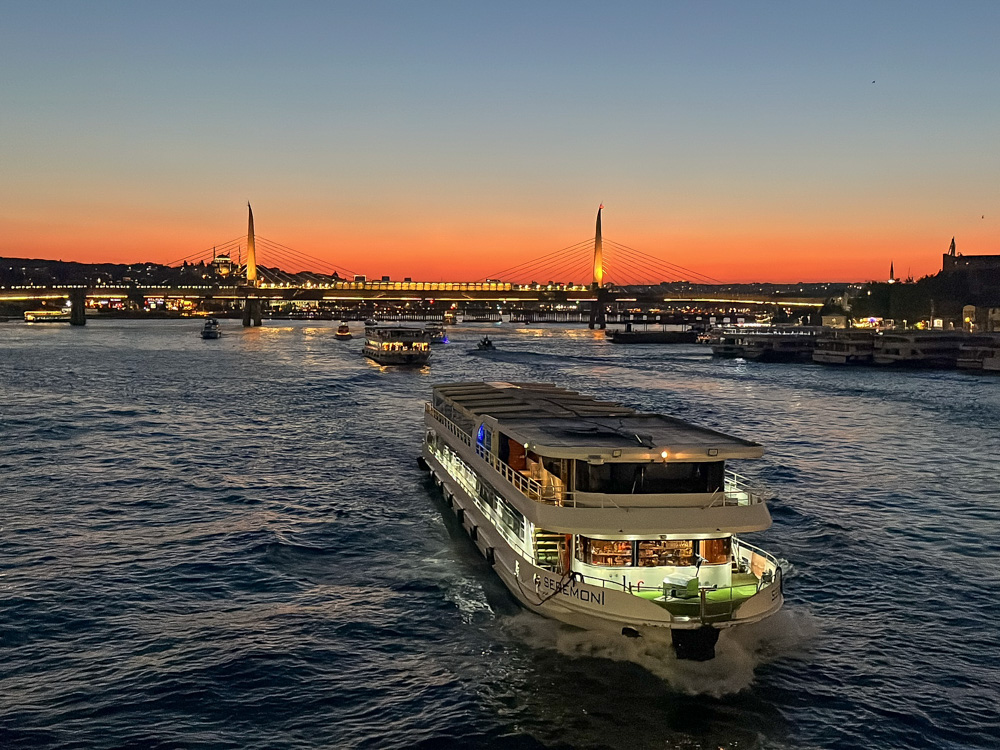
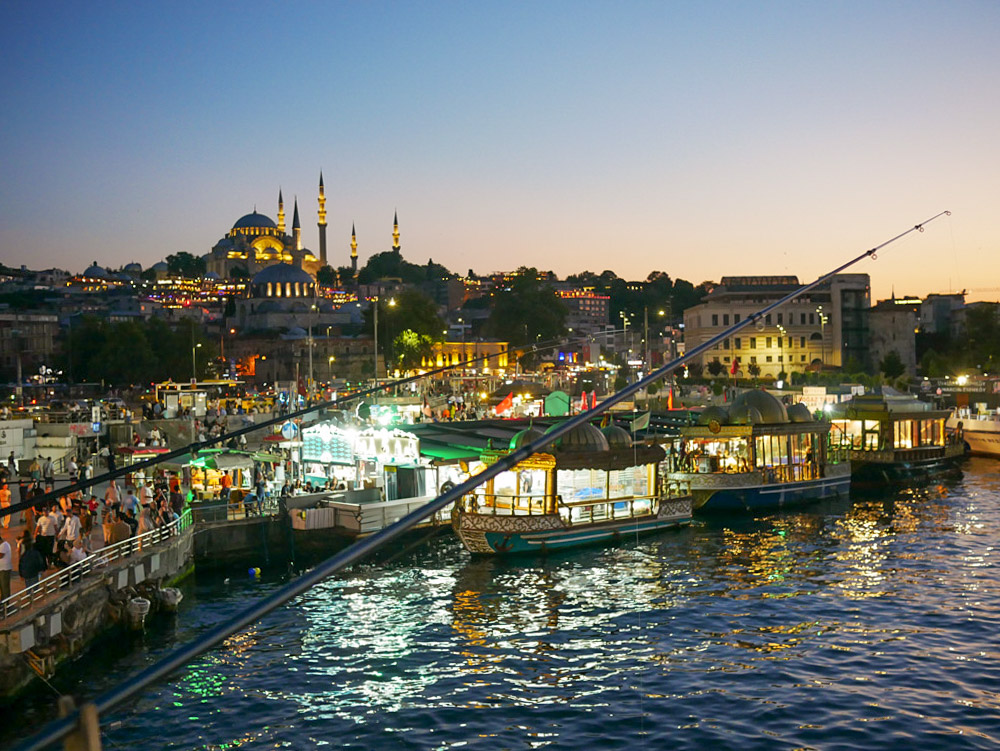
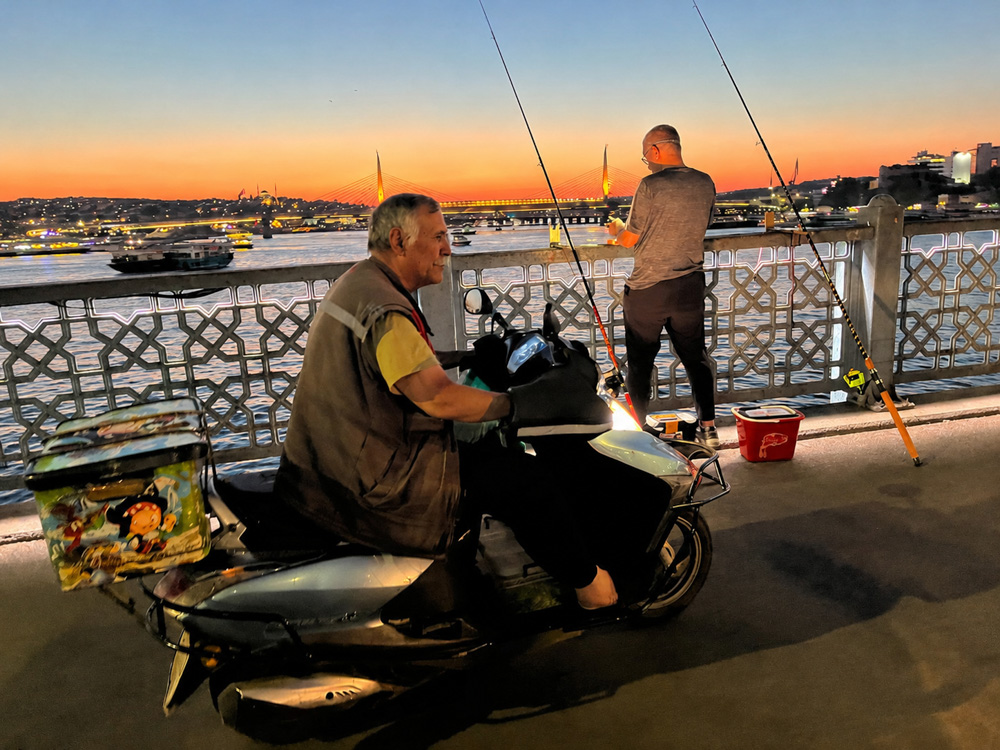
Evening on Galata Bridge, where fishermen cast their lines above the bustling waterfront, with the illuminated Süleymaniye Mosque dominating the skyline beyond.
Istanbul for Bosphorus lovers
Discover the finest places to admire Istanbul’s dazzling blue jewel